Will Drafting Services for Indians Living Abroad (NRIs & OCIs): The Complete Cross-Border Legal Guide (2026)
How Non-Resident Indians can protect their Indian real estate, NRE/NRO accounts, and Demat investments without flying to India or risking multi-year probate disputes.

Anuj Anand Malik
Reviewed by AMA Legal Solutions
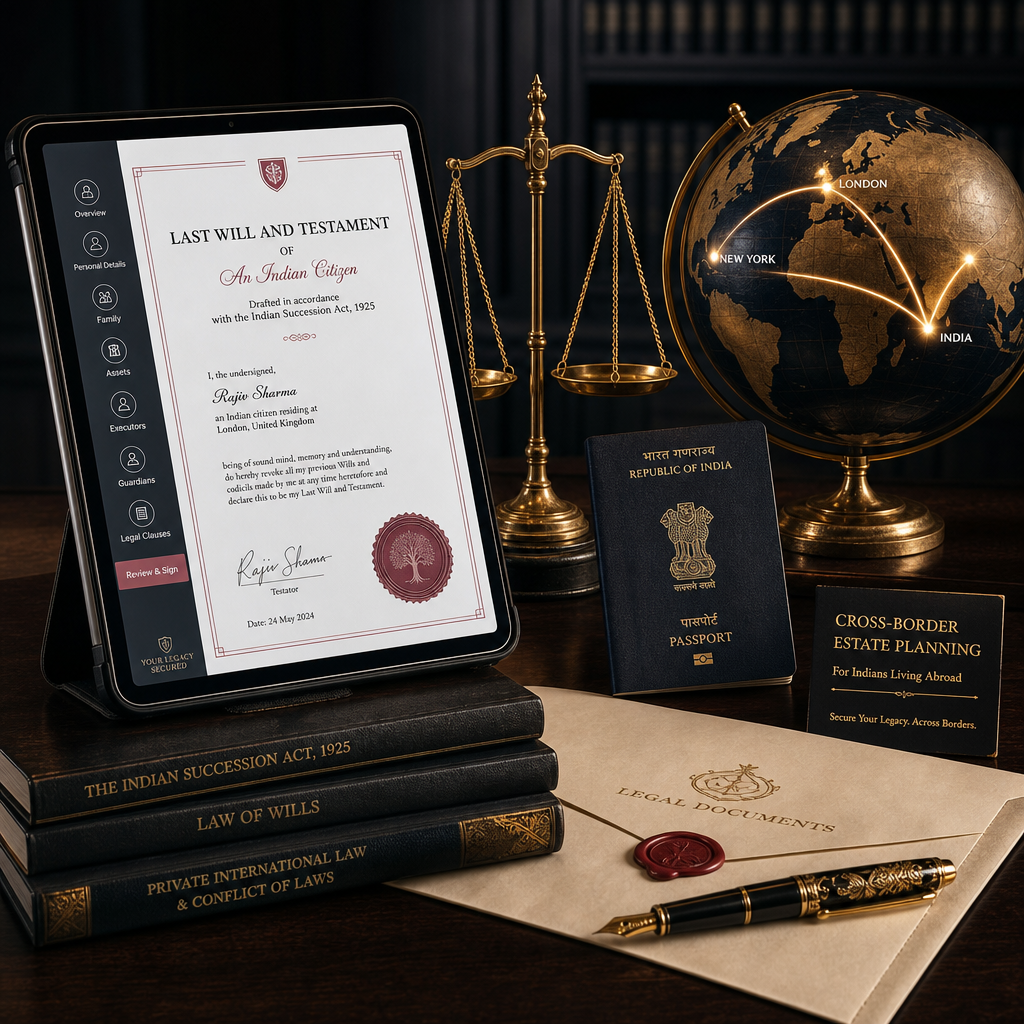
Key Takeaways: Non-Resident Indians (NRIs) and Overseas Citizens of India (OCIs) face unique cross-border legal challenges when managing estates spanning multiple jurisdictions. Under Indian law (Lex Situs rule), immovable property in India is governed exclusively by the Indian Succession Act, 1925, irrespective of where the NRI resides or holds citizenship. Relying on a single US, UK, Canadian, or UAE Will often triggers Section 228 probate re-sealing disputes that freeze Indian assets for years. The internationally accepted solution is the "Two-Will Strategy"—maintaining a dedicated, India-specific Will executed under Indian succession rules alongside your foreign estate plan.
1. The Cross-Border Inheritance Challenge: Why Foreign Wills Fail in India
Millions of Non-Resident Indians (NRIs), Person of Indian Origin (PIO), and Overseas Citizen of India (OCI) cardholders living in the United States, United Kingdom, United Arab Emirates, Canada, Australia, and Singapore retain substantial economic roots in India. These include residential apartments in Gurgaon, Bengaluru, Mumbai, or Pune, ancestral agricultural parcels, NRE/NRO fixed deposits, Demat portfolios, and family gold.
However, when an NRI passes away having executed only a foreign Will or a US Living Trust, their surviving family invariably encounters a bureaucratic and legal nightmare in India due to two foundational legal realities:
The Rule of Lex Situs (Section 5, Indian Succession Act, 1925)
Under Section 5(1) of the Indian Succession Act, 1925, succession to immovable property (land, flats, houses) situated in India is regulated strictly by the law of India (lex loci rei sitae or lex situs), regardless of the deceased's country of domicile, nationality, or tax residency at the time of death. Only movable property (cash, shares) follows the law of the country of domicile under Section 5(2).
The Section 228 Foreign Probate Trap
A grant of probate or letters of administration issued by a probate court in California, London, or Toronto holds no direct legal authority in India. Under Section 228 of the Indian Succession Act, 1925, when a foreign Will has been proved and probated abroad, the executor cannot simply walk into an Indian Sub-Registrar office or bank. They must file an ancillary petition before the competent Indian District Court or High Court to have an authenticated copy of the foreign probate recognized and re-sealed in India.
This process routinely takes between 18 and 36 months, involves high litigation expenses, requires costly Apostille certifications or Indian Embassy attestations, and frequently sparks contested litigation from distant relatives challenging the validity of the foreign decree.
2. The Gold Standard: The NRI "Two-Will Strategy"
To eliminate cross-border friction, senior succession lawyers and international estate planners unanimously recommend the Two-Will Strategy for global Indians:
- Will #1 (Overseas Estate): Governs exclusively your assets located in your country of residence (e.g., your home in Texas, 401(k) retirement accounts in the USA, ISAs in the UK, or properties in Dubai), drafted according to local state or national laws.
- Will #2 (Indian Estate): Governs exclusively your movable and immovable assets situated within the territorial boundaries of the Republic of India, drafted in strict compliance with the Indian Succession Act, 1925 and Hindu/Christian/Parsi/Muslim personal succession laws.
The Crucial "Non-Revocation Territorial Scope Clause"
The single greatest legal risk in cross-border estate planning is boilerplate revocation wording. Most standard Will templates begin with: "I hereby revoke all prior Wills, codicils, and testamentary dispositions made by me." If an NRI signs such a document in India or abroad, it unintentionally cancels their foreign estate plan!
Through WillDrafting.in's dedicated NRI Portal, every India-specific Will includes an explicit Territorial Scope and Non-Revocation Clause. It affirms that the Will applies solely to assets located within India and expressly preserves all foreign testamentary instruments, revocable trusts, or living wills governing properties outside India.
Single Foreign Will vs. Two-Will Strategy: Direct Comparison
| Estate Factor | Single Foreign Will / Living Trust | Two-Will Strategy (WillDrafting.in) |
|---|---|---|
| Indian Probate Process | Requires Section 228 court re-sealing in India; takes 18–36 months after overseas probate completes. | Instant parallel execution in India; immediate mutation and bank asset transfer. |
| Legal Costs & Expenses | Extremely high (dual-jurisdiction litigation fees, certified court copies, diplomatic apostilles). | Affordable, fixed-fee Indian Will drafting with zero cross-border court overhead. |
| Risk of Mutual Revocation | High risk that generic revocation clauses accidentally nullify foreign trusts or wills. | Protected by strict territorial exclusion clauses drafted by High Court advocates. |
| Bank & Asset Liquidity | Indian NRE/NRO accounts frozen indefinitely pending foreign court certificates. | Indian executor transfers funds and liquidates portfolios swiftly. |
3. Key Indian Assets That Require Specific Planning
A. Residential and Commercial Real Estate
Property mutation at the local Municipal Corporation or Revenue Department requires proof of legal succession. Having an India-specific Will stating exact municipal property identification numbers, registration details, and clear percentage divisions among legal heirs ensures smooth mutation into the beneficiary's name.
B. Agricultural Land and Farmhouses Under FEMA
This is a major pitfall for NRIs and OCIs. Under Section 6(5) of the Foreign Exchange Management Act (FEMA), 1999 and the FEMA (Non-Debt Instruments) Rules, 2019:
- NRIs and OCIs are prohibited from purchasing agricultural land, plantation property, or farmhouses in India.
- However, NRIs and OCIs CAN lawfully inherit agricultural land or farmhouses from a resident Indian via a valid testamentary Will or intestate succession.
- Crucially, if the NRI later decides to sell this inherited agricultural land, the sale can only be made to a resident Indian citizen.
C. NRE, NRO, and FCNR(B) Bank Accounts
Under landmark Supreme Court of India judgments (Sarbati Devi v. Usha Devi and Ram Chander Talwar v. Devender Kumar Talwar), a bank nominee is merely a collection agent or trustee. A nominee does not possess beneficial ownership. An India-specific Will supersedes bank nominations, ensuring that your accounts (and the interest earned thereon) devolve upon your chosen beneficiaries rather than being disputed among Class-I legal heirs.
D. Demat Accounts, Mutual Funds & Indian Shares
With thousands of NRIs invested in Indian equities via the Portfolio Investment Scheme (PIS) or mutual fund direct platforms, an India-specific Will provides clear instructions to depository participants (CDSL/NSDL) and AMCs for seamless transmission of shares without requiring indemnity bonds or court succession certificates.
4. How Can an NRI Execute a Legally Valid Indian Will from Abroad?
A common myth is that an NRI must physically travel to India, purchase non-judicial Indian stamp paper, or appear before an Indian Sub-Registrar to make a Will. This is completely incorrect under Indian law.
Section 63 Requirements for Overseas Execution:
- Plain A4 Paper: Under the Indian Stamp Act, 1899, Wills are 100% exempt from stamp duty. You can print your Will on plain white A4 paper in New York, London, Dubai, Toronto, or Sydney.
- Testator Signature: Sign or initial at the bottom of every page and sign fully at the conclusion of the Will.
- Dual-Witness Attestation: Under Section 63(c) of the Indian Succession Act, 1925, the Will must be signed in the simultaneous presence of two independent adult witnesses. The witnesses must watch you sign, and then sign in your presence.
- Witness Disqualification Rule: Under Section 67, an attesting witness must never be a beneficiary under the Will, nor the spouse of a beneficiary, as doing so voids the bequest to that person. Suitable witnesses can be colleagues, neighbours, or friends abroad.
Apostille vs. Indian Embassy Attestation:
While plain-paper execution before two witnesses fulfills Section 63 validity, having the signatures notarized and certified adds valuable evidentiary weight:
- In Hague Apostille Convention Countries (USA, UK, Canada, Australia, Singapore, EU): You can have your signature notarized by a local notary public and obtain an Apostille certificate from the competent local authority (such as the Secretary of State in the US or the Foreign, Commonwealth & Development Office in the UK). India is a member of the Hague Apostille Convention, meaning apostilled documents are recognized in Indian courts and registration offices without further consular legalization.
- In Non-Hague Jurisdictions (such as the UAE, Oman, Qatar): You can execute or notarize the document and have it authenticated at the Consular Section of the Indian Embassy (Abu Dhabi) or Indian Consulate (Dubai).

Halt Recovery Agent Harassment Legally
5. Repatriating Inherited Funds: FEMA and the RBI USD 1 Million Annual Limit
After Indian assets are liquidated or bank balances inherited into an NRO account, how can an NRI beneficiary legally remit the funds back to their overseas bank account?
Under the Reserve Bank of India (RBI) Remittance of Assets Regulations, an NRI or OCI beneficiary can remit up to USD 1,000,000 (One Million US Dollars) per financial year (April 1 to March 31) out of balances held in their NRO account representing the proceeds of inheritance or legacy.
Required Procedural Compliance:
- Form 15CB: A certificate issued by an Indian Chartered Accountant certifying that appropriate taxes have been paid or accounted for.
- Form 15CA: An online undertaking submitted on the Income Tax portal by the remitter.
- Zero Inheritance Tax in India: India abolished Estate Duty in 1985 and Wealth Tax in 2015. Under Section 56(2)(x) of the Income Tax Act, 1961, money or property received under a Will or by way of inheritance is completely exempt from income tax in India at the time of receipt. (Taxes only apply to subsequent capital gains when the inherited property or shares are sold).
6. Appointing an Indian Executor: Powers and Safeguards
Choosing the right executor is critical for NRIs. While you are legally permitted to appoint an NRI family member living abroad as your executor, doing so can cause administrative bottlenecks when visiting Indian banks, municipal offices, and tax departments.
Estate planning best practice recommends:
- Appointing a Resident Indian Co-Executor or Alternate Executor: A trusted sibling, family member, or professional in India who can physically represent the estate before Indian authorities.
- Granting Comprehensive Administrative Powers: Ensure your Will explicitly empowers the executor to apply for property mutation, operate and close bank accounts, manage Demat transmission, sign tax filings, and represent the estate in all administrative forums.
7. Helping Aging Parents in India: The NRI Child's Responsibility
Thousands of NRIs find themselves stranded when elderly parents living alone in Delhi, Punjab, Gujarat, Bengaluru, or Kerala pass away without a Will. The children are forced to take indefinite leave from their careers abroad, fly to India, navigate complex bureaucratic succession certificate filings, and negotiate with distant relatives.
Through WillDrafting.in, NRIs can actively assist their aging parents in creating an official, legally bulletproof Will:
- Bilingual (English & Hindi) Interface: Respectful, clear, and easy for senior citizens to comprehend.
- AI Voice Guidance: Older parents can listen to questions explained in simple spoken terms, removing the intimidation of legal jargon.
- Supervised by Bar Council Advocates: Practising High Court advocates from AMA Legal Solutions review the questionnaire, verify Class-I allocations, and ensure the Will cannot be contested later.
8. WillDrafting.in: Tailored Plans for Global Indians
Estate planning should not cost thousands of dollars in opaque international legal fees. Through WillDrafting.in Plans, NRIs and their families can choose clear, fixed-fee options with zero hidden charges:
- Auto Verified Plan (₹2,490 flat): Instant court-ready automated Will draft complying with the Indian Succession Act, asset schedules, executor/guardian designations, and dual-witness signing guides.
- Lawyer Verified Plan (₹4,990 flat - Most Popular): Line-by-line manual legal review by a senior succession advocate from AMA Legal Solutions, ensuring territorial clauses, personal law compliance, and statutory health check certification.
- Connect to Lawyer Plan (₹9,990 flat): Direct scheduled telephone/video consultation with a practising advocate for complex estates involving cross-border trusts, joint ancestral holdings, or business succession.
9. Conclusion: Protect Your Indian Roots with Professional Clarity
You have worked tirelessly to build a successful life abroad while preserving your heritage and investments in India. Leaving your Indian estate to statutory intestacy or an un-re-sealed foreign Will invites avoidable delays, disputes, and court litigation for the very family you seek to protect.
Take 15 minutes today to establish your Two-Will Strategy. Visit WillDrafting.in's NRI Portal to prepare your India-specific Will, or contact the cross-border legal advisory team at AMA Legal Solutions for specialized estate planning, NRI property mutation, and succession guidance.
Need Strategic Legal Defense for Your Situation?
Our banking & litigation advocates review your notices, debt liability, and recovery issues under complete advocate-client secrecy.

AMA Legal Solutions
Trusted with a 4.7 Google Rating, over 10,000+ Clients Served, 25,000+ Cases Handled, and more than 40+ Years of Experience in providing strategic legal defense and debt resolution across India.
Our media coverages





Frequently Asked Questions
Related Articles
Will Drafting Services for NRI: How Global Indians Can Protect Indian Assets from Abroad (2026)
A comprehensive legal guide on modern Will drafting services for Non-Resident Indians (NRIs) and OCIs managing real estate, bank accounts, and investments across India.
Read Article
Online Will Drafting in India: The Complete Legal Guide to Estate Planning (2026)
Protect your family's legacy, prevent bitter inheritance disputes, and discover how to create a legally binding, court-ready Will online under the Indian Succession Act, 1925.
Read Article
Repo Rate Impact on Loan Settlement: Understanding the Effects in 2026
Explore how repo rate fluctuations influence loan settlements and borrower strategies in India.
Read ArticleAbout Author
Anuj Anand Malik
View ProfileAnuj Anand Malik, Founder of AMA Legal Solutions, is a trusted advocate, loan settlement expert, legal advisor, and banking lawyer. With over a decade of experience in loan settlement, corporate law, financial disputes, and compliance, he leads a result-driven law firm based in India that helps individuals, startups, and businesses achieve legal and financial stability.
Connect on LinkedInNeed Legal Representation?
Evaluate your defense against recovery agents, notices, or structure your loan settlement directly with Senior Advocates.
Call +91-8700343611