CGTMSE & Mudra Collateral-Free Business Loan Settlement in India (2026)
Leverage the 85% CGTMSE guarantee cover to negotiate deep MSME OTS waivers.

Anuj Anand Malik
Reviewed by AMA Legal Solutions
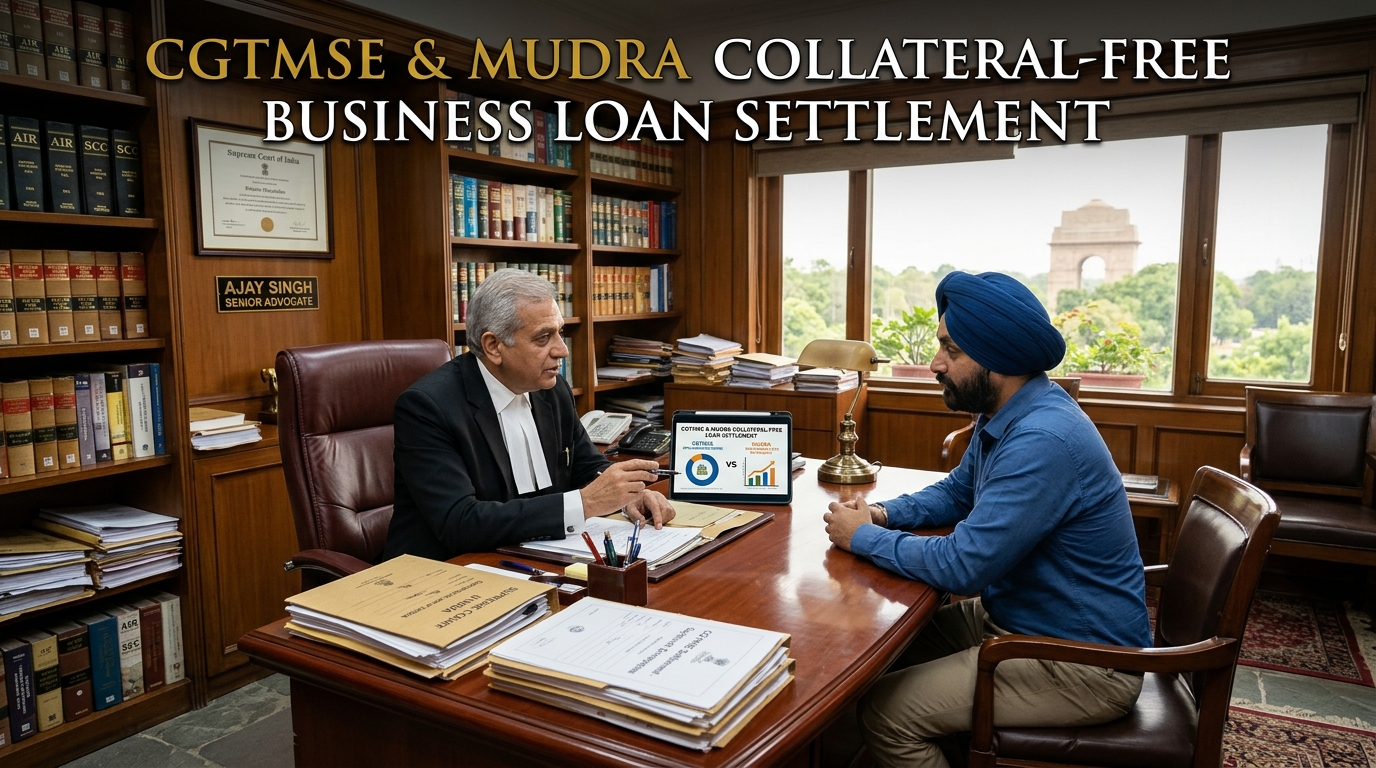
Key Takeaways: Defaulting on an unsecured MSME credit facility does not give lenders the right to seize your private residence or intimidate your family. If you are seeking cgtmse and mudra collateral free business loan settlement in india, you possess decisive legal leverage. Under Section 31 of the SARFAESI Act, 2002, banks cannot invoke summary property seizure without a registered mortgage. Furthermore, the Credit Guarantee Fund Trust for Micro and Small Enterprises (CGTMSE) and NCGTC reimburse lending banks up to 75% to 85% of defaulted principal balances. Understanding this underlying guarantee structure enables MSME promoters to stop third-party recovery harassment, invoke the mandatory RBI Framework for MSME Revival, and negotiate structured One-Time Settlements (OTS) at 15% to 35% of the ledger balance.
Introduction: Understanding CGTMSE and Mudra Collateral-Free Business Loan Settlement in India
Operating a micro, small, or medium enterprise (MSME) in India involves navigating severe market volatility, delayed trade receivables, and sudden cash-flow disruptions. When commercial revenues plunge and debt obligations mount, business founders frequently face mounting pressure on their working capital limits, term loans, and dropline overdrafts. For entrepreneurs holding unsecured government-backed facilities, understanding cgtmse and mudra collateral free business loan settlement in india is essential to defending personal dignity and achieving financial rehabilitation.
Every year, hundreds of thousands of Indian small business proprietors, traders, and manufacturers borrow through credit schemes like the Credit Guarantee Fund Trust for Micro and Small Enterprises (CGTMSE) or the Pradhan Mantri Mudra Yojana (PMMY). These facilities are specifically underwritten on a "collateral-free" basis to foster grassroots industrial growth without demanding equitable mortgages over ancestral agricultural land or self-occupied residential dwellings. However, when economic distress causes defaults, banking recovery departments and outsourced collection agencies frequently conceal the underlying statutory rules, threatening business owners with fabricated claims of immediate criminal prosecution, property attachment, and passport impoundment.
Navigating an unsecured commercial debt default requires a clear distinction between contractual civil liability and illegal recovery coercion. If your manufacturing unit, trading store, or logistics firm is facing mounting overdue notices, engaging in business loan settlement through recognized legal mechanisms provides an authorized, transparent path to extinguish liabilities permanently. With the assistance of qualified legal counsel, distressed borrowers can compel lending institutions to adhere to RBI fair practice mandates and arrive at mutually viable compromise closures.
How Collateral-Free CGTMSE & Pradhan Mantri Mudra Yojana (PMMY) Guarantees Actually Work
To master the dynamics of cgtmse and mudra collateral free business loan settlement in india, an enterprise owner must first understand the triangular legal relationship established between the borrowing entity, the Member Lending Institution (MLI—such as a public sector bank, private commercial bank, or NBFC), and the statutory guarantee trusts established by the Government of India.
The Architecture of the CGTMSE Scheme
Established jointly by the Ministry of Micro, Small and Medium Enterprises (MoMSME) and the Small Industries Development Bank of India (SIDBI), the CGTMSE trust operates as a statutory guarantor for credit facilities up to ₹5 Crore (and up to ₹10 Crore under expanded fintech and startup circulars). When a commercial bank sanctions a collateral-free loan under CGTMSE, the bank pays an Annual Guarantee Fee (AGF)—which is routinely debited directly from the borrower's loan account. In exchange, the Trust indemnifies the lending institution against financial default, promising to reimburse a predetermined percentage of the net loss incurred if the borrower's enterprise fails.
The Tripartite Structure of Pradhan Mantri Mudra Yojana (PMMY)
Similarly, micro-enterprises availing credit under PMMY access loans categorized across three distinct developmental tiers:
- Shishu Loans: Sanctions up to ₹50,000 for nascent micro-units, roadside retailers, and artisanal cottage workshops.
- Kishore Loans: Facilities from ₹50,001 up to ₹5,00,000 intended for machinery procurement, raw material stock, and small business expansion.
- Tarun Loans: Credit allocations from ₹5,00,001 up to ₹10,00,000 (with expanded limits up to ₹20,00,000 for proven track-record entrepreneurs) for established small enterprises.
Mudra loans are backed by the Credit Guarantee Fund for Micro Units (CGFMU), administered by the National Credit Guarantee Trustee Company (NCGTC). Just like CGTMSE, CGFMU provides institutional risk-mitigation guarantees to commercial banks, Regional Rural Banks (RRBs), Small Finance Banks (SFBs), and Microfinance Institutions (MFIs). In both schemes, the primary underwriting condition mandated by statutory directives is that the lending bank shall not obtain any collateral security or third-party guarantee from the applicant enterprise.
The Secret Banks Never Tell MSME Borrowers: The 75% to 85% CGTMSE Trust Claim Payout After NPA
The single most powerful lever in cgtmse and mudra collateral free business loan settlement in india is the payout structure executed between the lending bank and the guarantee trust once a business loan turns into a Non-Performing Asset (NPA). Bank branch managers and impaneled recovery agents routinely portray loan defaults as total losses that must be recovered entirely from the promoter's personal assets. In truth, the bank's actual net balance-sheet exposure is a small fraction of the ledger balance.
The Staggered Payout Mechanism: 75% First Installment
Under CGTMSE Operational Guidelines, when a covered loan account remains overdue for over 90 days and is classified as an NPA, the lending institution becomes entitled to lodge an interim guarantee claim after the expiry of the mandatory lock-in period (typically 18 months from guarantee activation or last disbursement, or 9 months for loans up to ₹10 Lakhs with tenures under 3 years):
- First Claim Installment (75% of Guaranteed Portion): Upon initial scrutiny and verification that the credit was disbursed according to scheme parameters, CGTMSE releases 75% of the guaranteed sum directly into the bank's suspense account. For an unsecured loan with an 85% guarantee coverage, this payout instantly recovers approximately 63.75% of the defaulted principal debt for the bank.
- Second Claim Installment (Remaining 25%): The balance 25% of the guaranteed amount is disbursed upon conclusion of legal recovery measures or three years following the first installment, subject to regulatory claim reconciliations.
Post-Claim Recovery and OTS Remittance Rules
Because the bank receives substantial reimbursement from the Trust, internal credit committees possess tremendous fiscal flexibility when assessing a One-Time Settlement (OTS). When evaluating options for cgtmse and mudra collateral free business loan settlement in india, commercial borrowers must recognize that the bank's internal credit policies actively account for these guarantee recoveries. However, statutory guidelines dictate that when a bank recovers funds from an MSME promoter following a guarantee claim, the recovery proceeds (net of documented, legitimate legal expenses) must be shared proportionately with CGTMSE via the portal's Recovery Module. For the borrower, this reality establishes that the bank's true commercial incentive is to secure a pragmatic cash settlement rather than carry dead, non-earning assets indefinitely.
Mandatory Guarantee Coverage Matrix
The following statutory matrix illustrates how the guarantee coverage functions across various loan sizes, demonstrating the true residual risk borne by lending banks:
| Loan Category & Facility Type | Borrower / Enterprise Classification | Statutory Guarantee Coverage (% Paid by Trust) | Residual Risk Borne by Bank | Typical OTS Compromise Settlement Range |
|---|---|---|---|---|
| CGTMSE Micro Credit (Up to ₹5 Lakh) | Micro Enterprises (Manufacturing & Services) | 85% of outstanding principal | 15% of principal balance | 15% to 25% of book balance |
| CGTMSE Women & Special Categories (Up to ₹50 Lakh) | Women Entrepreneurs, SC/ST, Agniveer & PwD Units | 85% to 90% of principal | 10% to 15% of principal balance | 15% to 30% of book balance |
| CGTMSE General MSE Credit (₹50 Lakh to ₹5 Crore) | Standard Micro and Small Enterprises | 75% of outstanding principal | 25% of principal balance | 25% to 40% of book balance |
| Mudra Shishu & Kishore (Up to ₹5 Lakh) | Micro Units, Petty Traders, Small Vendors | Up to 75% through CGFMU / NCGTC | 25% residual credit risk | 20% to 30% of principal ledger |
| Mudra Tarun Facilities (₹5 Lakh to ₹10 Lakh) | Growing Small Commercial & Industrial Firms | 75% through CGFMU Guarantee Pool | 25% residual credit risk | 25% to 35% of principal ledger |
| Special Regional Windows (NER, J&K, Ladakh) | Enterprises located in North-Eastern & Hill States | 80% of outstanding principal | 20% residual credit risk | 20% to 30% of book balance |
Armed with this verified data, MSME directors and sole proprietors can enter negotiations knowing that offers structured around 20% to 35% of the total ledger claim represent fair, economically rational outcomes for both the institution and the entrepreneur seeking a clean financial break.
Can a Bank Invoke the SARFAESI Act or Attach Your Personal House for an Unsecured CGTMSE / Mudra Loan?
The most pervasive threat issued by aggressive recovery agencies against stressed business founders is: "We are sending an enforcement team under the SARFAESI Act to seal your family residence tomorrow morning." When executing cgtmse and mudra collateral free business loan settlement in india, eliminating this unfounded panic is the first priority of an experienced legal advocate.
Section 31 of the SARFAESI Act, 2002: Absolute Statutory Exemption
The Securitisation and Reconstruction of Financial Assets and Enforcement of Security Interest (SARFAESI) Act, 2002, is an extraordinary legislative instrument designed strictly for the summary enforcement of security interests. Section 13(2) and Section 13(4) empower secured creditors to take physical possession of hypothecated or mortgaged immovable assets without prior intervention by a civil court.
However, Section 31 of the SARFAESI Act explicitly enumerates provisions where the Act does not apply. In particular, SARFAESI action is legally impossible where no security interest has been created. A collateral-free CGTMSE or Mudra loan, by definition and statutory design, involves zero mortgage over immovable property. Because there is no registered Memorandum of Deposit of Title Deeds (MODTD) or equitable mortgage registered with the Central Registry of Securitisation Asset Reconstruction and Security Interest (CERSAI), the bank possesses zero legal authority under SARFAESI. Consequently, when MSME proprietors initiate cgtmse and mudra collateral free business loan settlement in india, they hold statutory immunity against arbitrary property seizures under Section 13(4).
Legal Enforcement Powers: Collateral-Free vs. Secured Business Loans
To highlight the stark legal divide between secured loans and unsecured government-guaranteed facilities, review the statutory comparative matrix below:
| Legal Enforcement Dimension | Collateral-Free CGTMSE / Mudra Business Loan | Secured Business Loan / Loan Against Property (LAP) | Borrower Protection & Legal Remedies |
|---|---|---|---|
| Security Interest Registration (CERSAI) | None. No immovable property is pledged or registered. | Mandatory CERSAI registration of title deed deposit. | Section 31 of SARFAESI Act bars action without security interest. |
| SARFAESI Section 13(2) Demand Notice | Legally void and ultra vires if issued for purely unsecured debt. | Validly issued after 90 days of NPA classification. | Notice can be quashed via formal legal representation or High Court writ. |
| SARFAESI Section 13(4) Asset Possession | Completely illegal. Bank cannot seize residential or factory premises. | Bank can take symbolic and physical possession via DM order. | Police complaints & Section 17 DRT applications protect unsecured assets. |
| Debt Recovery Tribunal (DRT) Jurisdiction | Only applicable if total debt exceeds ₹20 Lakhs via formal Original Application (OA). | Applicable for both Section 13(4) measures and Section 19 recovery suits. | Requires formal trial; cannot bypass evidentiary standards. |
| Primary Recourse on Default | Lodge 75%-85% guarantee claim with CGTMSE / NCGTC Trust. | Public auction of mortgaged immovable property. | Trust payout absorbs primary institutional loss, incentivizing OTS. |
| Arbitration & Section 9 Interim Relief | Rare and limited; subject to arbitration agreement validity. | Frequently used alongside mortgage enforcement. | Arbitration awards cannot attach primary dwelling without court decree. |
As clearly established by Indian jurisprudence, if an institution issues a SARFAESI possession notice for a genuinely collateral-free CGTMSE or Mudra account, the notice is fundamentally defective and will be swiftly stayed or quashed by the Debt Recovery Tribunal (DRT) or the High Court under Article 226 of the Constitution of India.
Key Insights & Data Infographic
Visual summary, statistical trends & procedural breakdown
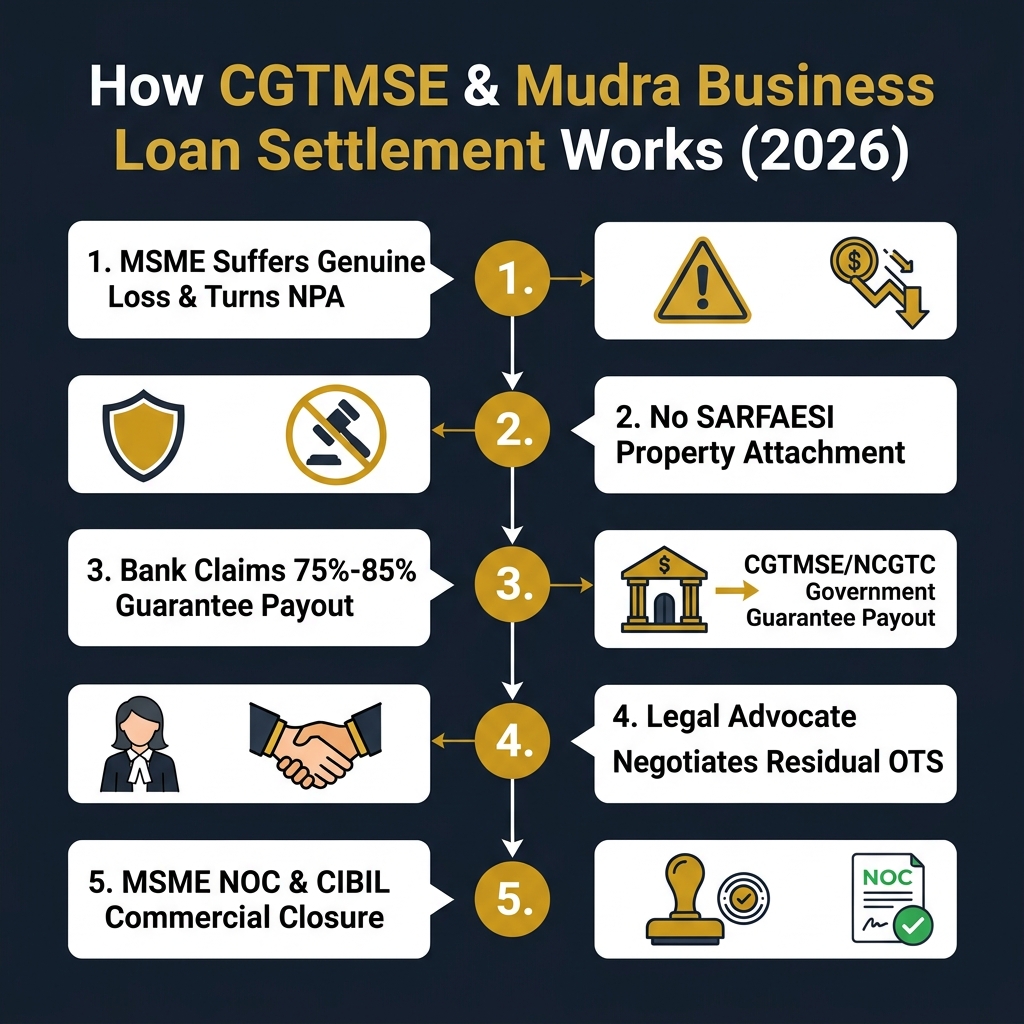
Prepared by AMA Legal Solutions Research & Analytics Team • Data & Compliance Overview

Halt Recovery Agent Harassment Legally
Debunking Recovery Agent Lies: 'Government Blacklisting', 'Passport Seizure' & 'FIR for Mudra Default'
When business owners face insolvency, collection agents leverage misinformation to induce psychological panic. During negotiations for cgtmse and mudra collateral free business loan settlement in india, borrowers are routinely subjected to aggressive intimidation tactics that violate both civil law and the penal code.
Myth 1: "Defaulting on a Mudra or PMEGP Loan is a Criminal Offense Resulting in Immediate Police Arrest"
The Legal Reality: In India, the failure to repay a commercial bank loan due to legitimate business failure is strictly a civil dispute arising from a breach of contract. As repeatedly affirmed by the Supreme Court of India, civil default does not constitute criminal cheating under Section 318 of the Bharatiya Nyaya Sanhita (BNS) (formerly Section 420 of the IPC). The police have zero legal authority to summon borrowers to police stations, register First Information Reports (FIRs) for simple defaults, or effect arrests. Criminal proceedings can only be initiated if the borrower fraudulently forged foundational balance sheets, submitted counterfeit KYC documents, or siphoned sanctioned loan capital into illicit ventures.
Myth 2: "The Bank Will Impound Your Passport and Blacklist Your Aadhaar Card"
The Legal Reality: Neither public nor private sector banks have the constitutional or statutory power to impound an Indian citizen's passport or disable an Aadhaar identification number. Under the Passports Act, 1967, only the designated Regional Passport Authority or a competent criminal court of law can revoke or impound a passport, and this power is reserved strictly for individuals facing formal criminal trial or specific Look Out Circulars (LOCs) in high-value economic fraud cases. A standard default on a Mudra Kishore or CGTMSE working capital loan does not qualify for travel restrictions or citizenship identity tampering.
Myth 3: "Recovery Agents Have Legal Authority to Raid Your Home and Seize Family Valuables"
The Legal Reality: Third-party recovery agents have no judicial or executive power. Under the Reserve Bank of India Master Directions on Fair Practices Code for Lenders, agents are strictly prohibited from:
- Calling borrowers before 8:00 AM or after 7:00 PM.
- Visiting family residences without prior written intimation and official bank identification.
- Contacting business clients, suppliers, neighbors, or relatives to disclose debt distress.
- Using uncivil, threatening, or abusive language.
Engaging in these forbidden actions constitutes criminal intimidation and intentional insult under the Bharatiya Nyaya Sanhita. When business operators instruct a reputable legal team to manage recovery agent harassment, these illegal collection antics cease immediately.
RBI Framework for Revival and Rehabilitation of MSMEs (Up to Rs. 25 Crore): Mandatory Committee Review Before NPA
One of the most neglected statutory defenses in cgtmse and mudra collateral free business loan settlement in india is the landmark RBI Framework for Revival and Rehabilitation of Micro, Small and Medium Enterprises (MSMEs), originally notified under Section 9 of the Micro, Small and Medium Enterprises Development (MSMED) Act, 2006.
The Mandated Special Mention Account (SMA) Surveillance System
Under RBI directions, banks are legally mandated to recognize financial stress at its earliest inception rather than waiting for an account to turn into an NPA after 90 days of non-payment. Lenders must categorize stressed accounts into three formal surveillance brackets:
- SMA-0: Principal or interest payment not overdue for more than 30 days, but showing identifiable signs of operational or sectoral stress.
- SMA-1: Overdue period ranging between 31 and 60 days.
- SMA-2: Overdue period ranging between 61 and 90 days.
The Mandatory Committee for Stressed MSMEs
For any MSME borrower having aggregate loan limits exceeding ₹10 Lakhs up to ₹25 Crores, the lending bank is statutorily obligated to refer the stressed loan account to an internal specialized forum known as the Committee for Stressed MSMEs before taking coercive legal recovery steps. This Committee comprises:
- The Bank's Regional/Zonal Head of MSME Banking (Chairperson).
- An independent technical expert with domain knowledge in the borrower's industrial sector.
- A senior credit risk officer from an uninvolved vertical.
- A representative designated by the State Government or MSME Directorate (in select cases).
The Committee is legally tasked with exploring three successive options under a formal Corrective Action Plan (CAP): Rectification (infusing temporary liquidity or regularizing documentation), Restructuring (extending repayment tenures, granting principal moratoria, and reducing interest margins), or Recovery (evaluating One-Time Settlement or compromise write-offs). Invoking this supervisory committee review provides vital strategic breathing room when pursuing cgtmse and mudra collateral free business loan settlement in india, forcing lenders to table compromise solutions before initiating premature recovery litigation. If a bank fails to convene this Committee or summarily rejects an MSME's formal restructuring application prior to initiating aggressive recovery, the entire subsequent recovery process can be challenged before judicial authorities as a violation of binding RBI statutory circulars.
For entrepreneurs running micro units holding MSME registration and compliance, asserting your enterprise status under the MSMED Act ensures that your enterprise is treated as an economic asset deserving rehabilitation rather than a delinquent debtor subject to arbitrary recovery actions.
Step-by-Step Process to Settle CGTMSE, Mudra & Dropline Overdraft Loans via One-Time Settlement (OTS)
Achieving a legally binding, discount-maximized cgtmse and mudra collateral free business loan settlement in india requires a disciplined, step-by-step approach. Navigating this framework alongside experienced banking advocates ensures that your rights remain safeguarded throughout every phase of the negotiation.
Step 1: Forensic Portfolio Audit and Debt Segregation
The process begins with an in-depth audit of all outstanding facilities. A dedicated loan settlement service will dissect your loan agreements, sanction letters, and statement of accounts. This stage verifies:
- Whether the credit was officially registered under CGTMSE or CGFMU (PMMY), and if the bank claimed the Annual Guarantee Fee from your account.
- Whether illegal compound penal interest, unannounced inspection fees, or excessive processing charges were unlawfully capitalized into the ledger balance.
- Whether any collateral or third-party guarantee was improperly procured in violation of scheme mandates.
Step 2: Issuing a Cease-and-Desist Notice Against Harassment
To eliminate psychological stress and halt unlawful recovery tactics, your legal counsel issues a formal Cease-and-Desist Legal Notice to the bank's Managing Director, Principal Nodal Officer, and collection agency heads. The notice cites RBI Master Directions on Recovery Agents, relevant High Court rulings, and BNS provisions against harassment. This establishes that all future communications regarding the debt must be directed exclusively through your appointed legal counsel.
Step 3: Documenting Bona Fide Business Hardship
Lenders do not grant deep OTS waivers to willful defaulters; they grant settlements to enterprises that have suffered genuine economic misfortune. Your advocates assemble a comprehensive "Hardship Dossier", which includes:
- Audited financial statements and tax returns demonstrating declining turnover and operational losses.
- Bank account statements illustrating customer defaults, canceled export orders, or bad trade debts.
- Supporting evidence such as factory lease terminations, GST cancellation notices, or medical hardship certificates.
This empirical evidence satisfies the bank's internal recovery policy guidelines, proving that a prompt One-Time Settlement offers the bank a far superior financial recovery than protracted, expensive litigation against an asset-less business.
Step 4: Formal Submission of the OTS Compromise Proposal
Your advocates draft a precise, commercially grounded OTS proposal addressed to the competent authority (such as the Circle Settlement Committee or Zonal Credit Committee). The proposal highlights:
- The collateral-free nature of the facility and the inapplicability of SARFAESI under Section 31.
- The bank's access to the 75% to 85% CGTMSE or NCGTC guarantee payout.
- A realistic, single-bullet or structured milestone settlement offer—typically between 15% and 35% of the principal outstanding—contingent upon full waiver of penal interest, legal charges, and future interest.
Whether you require loan settlement for traders and wholesalers or specialized loan settlement for textile owners, tailoring the proposal to your industry's specific asset profile ensures optimal receptivity from credit committees.
Step 5: Securing the Formal Bank Sanction Letter and Executing Payment
Never transfer funds to a recovery agent or pay against verbal assurances from branch officials. A valid compromise settlement is concluded only when the bank issues an official, stamped, and signed OTS Sanction Letter on corporate letterhead, explicitly detailing:
- The agreed settlement amount and exact payment due dates.
- An explicit clause stating that upon receipt of the agreed sum, the account will be closed in full and final satisfaction of all claims.
- A commitment to withdraw all pending legal suits, DRT proceedings, and Section 138 NI Act complaints.
- A timeline for updating credit information companies (CIBIL, Experian, CRIF High Mark).
Step 6: Procuring the No Dues Certificate (NOC) and Commercial Credit Rectification
Following final payment, your legal team secures the unconditional No Dues Certificate (NDC) from the bank. Furthermore, counsel ensures that the account is updated across Commercial CIBIL bureaus as "Settled" or "Post-Settlement Closed", ensuring complete immunity from future collection actions by asset reconstruction companies (ARCs) or third-party debt collectors. By adhering to this disciplined legal protocol, completing a successful cgtmse and mudra collateral free business loan settlement in india safeguards the promoter's personal financial future while permanently closing corporate liabilities.
Strategic Conclusion: Close Your Distressed MSME Debt Legally with AMA Legal Solutions
Suffering a commercial enterprise collapse or severe cash-flow crisis is an unfortunate reality of entrepreneurship, not a moral failure or criminal act. Millions of resilient Indian business leaders who once found themselves trapped under unpayable loans have rebuilt their commercial futures by utilizing authorized legal frameworks. For any promoter facing unmanageable business liabilities, cgtmse and mudra collateral free business loan settlement in india offers a legitimate, statutory mechanism to protect your livelihood and achieve lasting debt freedom.
Navigating public sector bank settlement committees, responding to aggressive legal notices, and managing recovery agents requires uncompromising advocacy and deep expertise in Indian banking jurisprudence. Attempting to negotiate with seasoned institutional recovery committees without legal representation often results in unfavorable terms, inflated settlement figures, and ongoing vulnerability to residual debt claims.
At AMA Legal Solutions, our dedicated team of senior advocates and banking specialists provides end-to-end protection for distressed MSME founders across the nation. We step between you and predatory lenders, immediately halt recovery intimidation, leverage statutory CGTMSE guarantee guidelines to minimize your liability, and secure ironclad One-Time Settlement closures. If you are struggling with unpaid working capital limits, term loans, or Mudra facilities, take control of your commercial future today. Explore our proven loan settlement in India or business loan settlement for Indians programs, and contact AMA Legal Solutions for a confidential, comprehensive case evaluation.
Popular Searches & Topics
Commonly searched legal queries and keywords related to this article
Need Strategic Legal Defense for Your Situation?
Our banking & litigation advocates review your notices, debt liability, and recovery issues under complete advocate-client secrecy.
References & Authority
- Reserve Bank of India - Framework for Revival and Rehabilitation of Micro, Small and Medium Enterprises (MSMEs)
- Credit Guarantee Fund Trust for Micro and Small Enterprises (CGTMSE) - Official Scheme Guidelines & Payout Rules
- National Credit Guarantee Trustee Company (NCGTC) - Credit Guarantee Fund for Micro Units (CGFMU) Scheme
- Ministry of Micro, Small and Medium Enterprises - MSMED Act, 2006 Statutory Framework
- Pradhan Mantri MUDRA Yojana (PMMY) - Operational Guidelines & Guarantee Pool
- Securitisation and Reconstruction of Financial Assets and Enforcement of Security Interest Act, 2002 - Section 31 Exemptions
- Reserve Bank of India - Master Direction on Fair Practices Code for Lenders and Debt Collection Standards
- Insolvency and Bankruptcy Board of India (IBBI) - Pre-packaged Insolvency Resolution Process for MSMEs Regulations

AMA Legal Solutions
Trusted with a 4.7 Google Rating, over 10,000+ Clients Served, 25,000+ Cases Handled, and more than 40+ Years of Experience in providing strategic legal defense and debt resolution across India.
Our media coverages





Frequently Asked Questions
Related Articles
Received A DRT / Sarfaesi Notice? A Borrower’s And Guarantor’s Guide To Response Timelines And Defences
Essential steps and defenses for borrowers and guarantors facing DRT/Sarfaesi notices in India.
Read Article
Why You Should Not Go to an Agency for Loan Settlement but a Lawyer or Law Firm
Understanding the benefits of legal expertise over agencies in loan settlements.
Read Article
Best Lawyer for Loan Settlement? Find Your Expert in 2026
Discover top strategies and insights for finding the best lawyer for loan settlement.
Read ArticleAbout Author
Anuj Anand Malik
View ProfileAnuj Anand Malik, Founder of AMA Legal Solutions, is a trusted advocate, loan settlement expert, legal advisor, and banking lawyer. With over a decade of experience in loan settlement, corporate law, financial disputes, and compliance, he leads a result-driven law firm based in India that helps individuals, startups, and businesses achieve legal and financial stability.
Connect on LinkedInNeed Legal Representation?
Evaluate your defense against recovery agents, notices, or structure your loan settlement directly with Senior Advocates.
Call +91-8700343611