Will My Salary Account Be Auto Debited If I Go for Loan Settlement or Can It Be Marked Freeze or Lien?
When a borrower defaults or initiates loan settlement discussions, lenders frequently weaponize automated clearing house debits and threaten account freezes. Understanding whether your salary account will be automatically debited via NACH or subjected to an internal banker's lien under Section 171 of the Indian Contract Act is essential to protecting your monthly livelihood.

Reviewed by AMA Legal Solutions
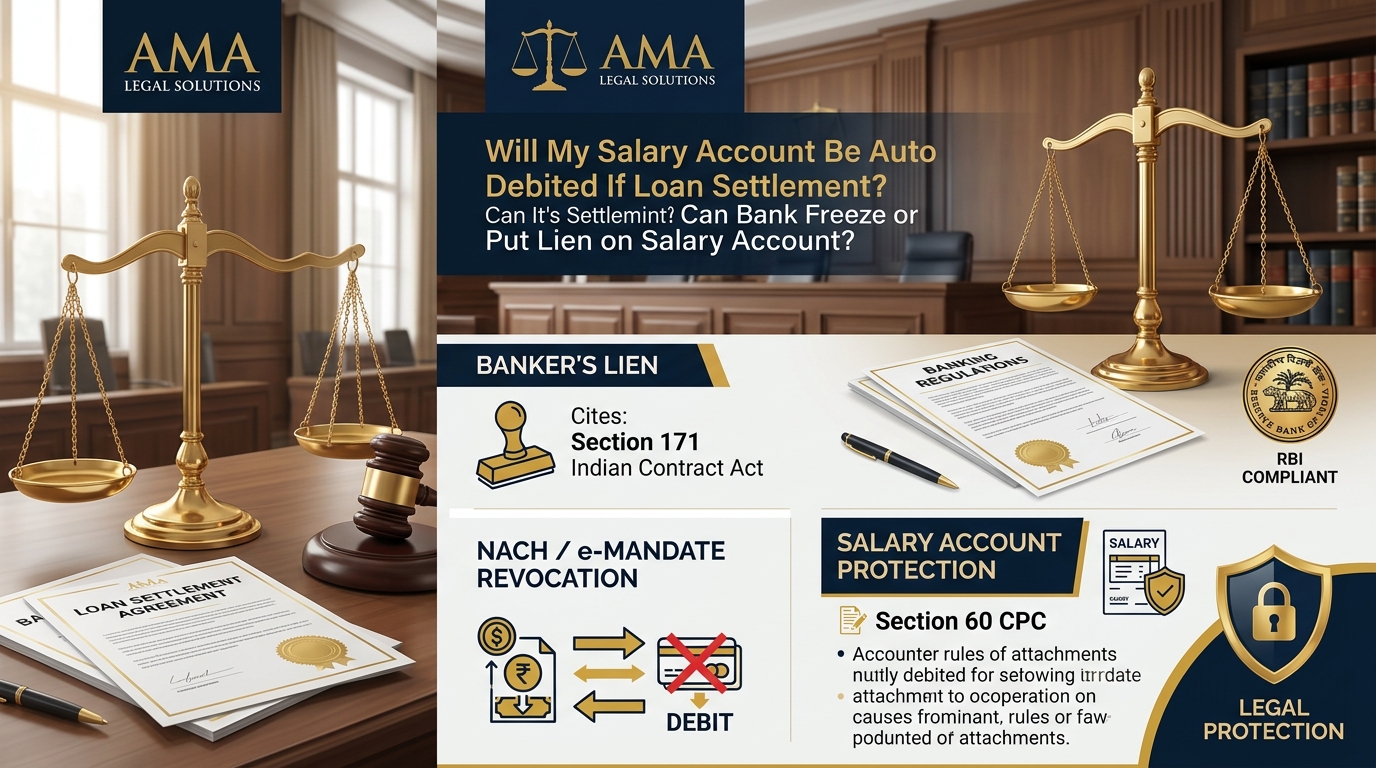
⚡ Quick Legal Answer: Will My Salary Account Be Auto Debited or Marked Freeze/Lien During Loan Settlement?
A salary account will continue to be auto-debited via NACH or e-Mandate during loan settlement negotiations unless the borrower formally submits a written mandate revocation notice citing National Payments Corporation of India (NPCI) guidelines and Reserve Bank of India (RBI) Fair Practices directives. If the salary account is maintained at the exact same lending bank, the bank may attempt to exercise a unilateral right of set-off or banker's lien under Section 171 of the Indian Contract Act, 1872; however, judicial precedents prohibit banks from seizing essential subsistence earnings protected under Section 60(1)(i) of the Code of Civil Procedure, 1908 and Article 21 of the Constitution of India. Conversely, if the salary account is held with an independent third-party bank, the lending institution has zero legal authority to freeze, place a lien upon, or debit the account without a formal court decree or garnishee order under Order XXI Rule 46 of the Code of Civil Procedure.
Can Your Salary Account Be Auto-Debited During Loan Settlement? (NACH, e-Mandates & Standing Instructions)
When a borrower experiences genuine financial distress—such as acute business cash crunch, medical emergency, or unexpected job transition—and approaches a bank or Non-Banking Financial Company (NBFC) for a structured One-Time Settlement (OTS), a dangerous procedural disconnect often occurs. While the credit recovery or legal department entertains settlement proposals, the automated payment clearing machinery operates on rigid, automated schedules.
Under the National Automated Clearing House (NACH) system governed by the National Payments Corporation of India (NPCI) and the Payment and Settlement Systems Act, 2007, an electronic mandate operates continuously until its pre-configured expiry date or until a formal revocation instrument is lodged. Lenders do not automatically cancel or suspend electronic debit mandates simply because an informal email or verbal request for loan settlement has been submitted. Consequently, on the scheduled installment date, the automated clearing sweep attempts to pull the full Equated Monthly Installment (EMI) from the borrower's salary account.
If funds are present in the salary account, the automated clearing run executes, depleting money earmarked for urgent living expenses, rent, and legal advisory fees. If the account contains insufficient funds, each failed debit run triggers severe penal bounce charges by both the lending institution and the destination bank. More critically, repeated automated dishonors create statutory grounds for lenders to issue penal notices under Section 25 of the Payment and Settlement Systems Act, 2007 or Section 138 of the Negotiable Instruments Act, 1881. Therefore, formally pausing and revoking active NACH mandates through advocate-issued notice is the indispensable first step before entering into any settlement discussions.
Commercial Reality: Transparent Fixed Legal Advisory vs Free DIY Templates vs Corporate Law Firms
When salaried individuals face the prospect of account freezes or unauthorized debits during loan default, navigating legal options can be daunting. Many distressed borrowers fall into two dangerous extremes: relying on free, unvetted DIY online letters downloaded from internet forums, or approaching elite corporate law firms that demand crippling monthly retainers. Understanding the commercial and procedural realities of these choices is essential to preserving both your monthly income and your legal rights.
| Evaluation Metric | Free Online DIY Templates | AMA Legal Solutions (Fixed Advisory) | Corporate Law Firms |
|---|---|---|---|
| Statutory Authority & Enforceability | Zero legal standing; ignored by bank legal desks; risks fatal debt admissions. | Advocate-certified drafting under Advocates Act, 1961; enforceable across civil courts. | High statutory standing; formal court appearance capability. |
| Fee Structure & Transparency | Free initially, but causes severe secondary bounce charges and litigation losses. | Transparent fixed legal advisory without hourly markups or surprise retainers. | Excessive corporate retainers, unpredictable hourly billing, and clerical surcharges. |
| NACH Revocation & UMRN Handling | Generic text lacking specific destination bank routing and NPCI circular citations. | Comprehensive UMRN audit, formal bank service, and interim stay on auto-debits. | Handled through junior associates with extensive bureaucratic turnaround times. |
| Lien Defense & Section 60 CPC Pleading | Cannot articulate constitutional subsistence protections or High Court precedents. | Immediate cease-and-desist notices invoking Radhika v. SBI and Article 21 rights. | Capable, but requires prohibitive litigation retainers for simple pre-litigation notices. |
| Confidentiality & Privilege | None; unprotected internet data vulnerable to scraping and commercial exploitation. | Strict statutory attorney-client privilege under Section 126 of the Indian Evidence Act. | Full privilege maintained under corporate legal retainers. |
By choosing advocate-certified representation under a transparent fixed legal advisory model, borrowers eliminate open-ended legal bills while securing airtight statutory protections that compel financial institutions to halt unauthorized debits and negotiate settlements on equitable terms.
The Banker's Right to General Lien & Set-Off (Section 171, Indian Contract Act, 1872)
The most alarming scenario for a salaried borrower occurs when their employer deposits their monthly paycheck into an account held at the exact same bank where an overdue personal loan, business overdraft, or credit card is outstanding. Under such circumstances, lenders frequently execute an internal freeze, commonly referred to as a “banker's lien” or “right of set-off.”
Statutorily, Section 171 of the Indian Contract Act, 1872 provides that bankers may, in the absence of a contract to the contrary, retain as a security for a general balance of account, any goods bailed to them. Through extended commercial practice, banks interpret this right alongside the equitable doctrine of set-off, which allows a creditor to combine accounts and apply credit balances in one account against debit balances in another, provided both accounts stand in the exact same legal capacity and mutuality.
Section 171, Indian Contract Act, 1872: “Bankers, factors, wharfingers, attorneys of a High Court and policy-brokers may, in the absence of a contract to the contrary, retain as a security for a general balance of account, any goods bailed to them; but no other persons have a right to retain, as a security for such balance, goods bailed to them, unless there is an express contract to that effect.”
However, financial institutions routinely exceed their statutory mandate by asserting an absolute, unfettered right to freeze an employee's salary without prior notice. The judiciary has repeatedly circumscribed this practice:
- Requirement of Mutuality of Capacity: A bank cannot exercise a general lien over deposits held in a fiduciary, trust, or special-purpose capacity. If funds are deposited specifically as remuneration for personal labor and sustenance, mutuality of commercial debt is strictly contested.
- Mandatory Prior Notice: As held in multiple landmark rulings, a banker must issue reasonable prior written notice specifying the intent to exercise set-off, providing the customer an opportunity to explain their financial hardship or arrange basic living funds.
- Prohibition on Total Livelihood Seizure: Freezing 100% of a salary account unlawfully deprives an individual of the means of existence, contravening constitutional safeguards and specific statutory exemptions under civil execution codes.
Same Bank vs Different Bank Salary Account: Crucial Legal Distinctions
Whether your salary account can be frozen or marked with a lien depends entirely on whether your payroll account is maintained with the lending institution or with an independent, separate scheduled commercial bank. Borrowers must understand the critical legal wall separating these two environments:
- Salary Account in the Same Lending Bank: If your salary is credited to the bank where your defaulted loan exists, the bank holds both the deposit ledger and the debt ledger. Through internal software controls, the branch or recovery wing can unilaterally mark a lien under Section 171 of the Indian Contract Act or trigger automatic internal transfers. In such cases, requesting your employer's human resources department to update your salary disbursement mandate to an independent third-party bank is essential.
- Salary Account in a Different Bank: A lending bank or NBFC has ZERO legal authority, contractual privity, or banker's lien over deposit accounts in another bank. A rival bank CANNOT freeze your funds simply because an outside lender claims default. A third-party bank can only freeze or attach funds upon receiving a formal court decree, a garnishee order under Order XXI Rule 46 CPC, or a police notice under CrPC.
Recovery agents frequently threaten defaulted borrowers by claiming they will freeze every account across all banks linked to their PAN. This claim is completely fictitious and legally impossible without formal judicial decrees.
Statutory Protection of Salary Under Section 60 CPC & Article 21 of the Constitution
The Indian legal system explicitly recognizes that debt recovery cannot be executed in a manner that starves a citizen or deprives their family of fundamental subsistence. Even in the formal judicial enforcement of a civil court money decree, the Parliament of India codified strict statutory exemptions under Section 60 of the Code of Civil Procedure, 1908 (CPC).
Section 60(1)(i), Code of Civil Procedure, 1908: “Provided that the following particulars shall not be liable to such attachment or sale, namely:— salary to the extent of the first one thousand rupees and two-thirds of the remainder in execution of any decree other than a decree for maintenance.”
This statutory formula ensures that a substantial majority of a salaried worker's earnings remains completely untouchable by creditors. Furthermore, the Supreme Court of India has ruled in multiple constitutional judgments that the right to livelihood forms an integral, non-negotiable core of the Right to Life guaranteed under Article 21 of the Constitution of India.
5-Step Statutory Protocol to Safeguard Your Salary Account During Loan Settlement
- Comprehensive NACH & e-Mandate Audit: Identify all active mandates linked to your salary account. Extract the Unique Mandate Reference Number (UMRN), presentation dates, maximum debit caps, and recipient financial entities.
- Advocate-Drafted Statutory Mandate Revocation: Serve a formal revocation notice to both the destination bank and the lender citing NPCI Procedural Guidelines and RBI Fair Practices Code, instructing the bank to stop honoring electronic debit presentations.
- Strategic Payroll Account Migration: If your salary is currently credited to the lending bank, immediately notify your employer's payroll department to switch future disbursements to a fresh, independent scheduled bank where you hold no debt obligations.
- Cease-and-Desist Notice Against Unlawful Liens: Issue a pre-emptive legal notice warning the lender against unlawful Section 171 lien marking, citing Section 60 CPC wage protections and Supreme Court precedents prohibiting harassment and extrajudicial asset freezing.
- Formal Settlement Structuring & Written Debit Moratorium: Execute formal One-Time Settlement (OTS) negotiations under advocate representation, ensuring the settlement agreement explicitly mandates zero debit runs, waiver of all bounce charges, and issuance of a clean No Dues Certificate (NDC).
Key Insights & Data Infographic
Salary Account Protection, NACH Revocation & Section 171 Lien Framework
Prepared by AMA Legal Solutions Research & Analytics Team • Banking Law & Compliance Overview
Legal Procedure to Cancel NACH / ECS Mandates Without Triggering Criminal Allegations
One of the most persistent concerns for salaried borrowers is whether canceling a NACH mandate or requesting their bank to stop payment constitutes a criminal offense. Under Indian banking jurisprudence, revoking an electronic mandate is a legitimate contractual act; however, the manner and timing in which it is executed dictate whether criminal exposure can arise.
Under NPCI circulars, a customer has the legal right to revoke an e-Mandate or NACH debit through their sponsor bank or destination bank. However, simply clicking “Stop Debit” in internet banking without legal notice often causes the clearing system to record the failure as “Account Closed” or “Payment Stopped by Drawer.” Lenders routinely weaponize such return codes to allege fraudulent intent under Section 25 of the Payment and Settlement Systems Act, 2007.
When an advocate drafts the mandate revocation, the communication clearly establishes that the mandate is being paused due to bona fide financial incapacity and that the borrower is actively pursuing formal restructuring or loan settlement under RBI guidelines. This contemporaneous legal record shuts down allegations of deliberate fraud or bad-faith evasion.
Defending Against Section 25 PSS Act & Section 138 NI Act Bounces
If an auto-debit fails or a post-dated security cheque bounces, lenders typically issue a statutory demand notice giving the borrower fifteen days to pay. Section 25 of the Payment and Settlement Systems Act, 2007 mirrors Section 138 of the Negotiable Instruments Act, 1881 in its punitive structure.
However, establishing a criminal offense under Section 25 requires proof of a legally enforceable debt at the exact time of debit presentation and a failure to rectify following valid statutory notice. When an advocate handles your loan settlement, a comprehensive reply is issued within the mandatory 15-day window, placing on record genuine hardship, arbitrary charges, and active settlement negotiations, effectively destroying the prosecutorial foundation for criminal trial.
What to Do If Your Salary Account Is Already Frozen or Marked with a Lien
If you discover that a lien has already been placed on your salary account or your balance shows as negative due to an internal hold, prompt legal action is critical:
- Demand Written Legal Basis: Immediately submit a formal written demand to the branch manager requesting the specific statutory section or court order number under which the lien was marked.
- Serve Advocate Legal Notice: Have a banking advocate issue an urgent legal notice challenging the lien under Section 171 Indian Contract Act, citing Section 60(1)(i) CPC wage exemptions.
- Escalate to the RBI Integrated Ombudsman: Lodge an expedited digital complaint under Clause 10 of the Reserve Bank - Integrated Ombudsman Scheme, 2021.
- File an Urgent Consumer Complaint: Approach the District Consumer Disputes Redressal Commission under Section 35 of the Consumer Protection Act, 2019 seeking an immediate interim order unfreezing the account.
Key Judicial Precedents & RBI Directives on Bank Account Attachment
- Radhika v. State Bank of India (Kerala High Court): The High Court ruled that a bank cannot freeze a customer's account or withhold funds deposited for basic sustenance without due process of law. The banker's right of lien under Section 171 cannot override constitutional guarantees of life and personal dignity under Article 21.
- ICICI Bank Ltd. v. Prakash Kaur (Supreme Court of India): The Apex Court condemned coercive and strong-arm recovery tactics by financial institutions, affirming that all debt recovery procedures must strictly comply with the rule of law.
- RBI Master Direction on Fair Practices Code for Lenders: Mandates that banks and NBFCs must refrain from unwarranted interference in the affairs of borrowers and provide clear grievance redressal mechanisms prior to initiating coercive recovery.
References & Authority
- Reserve Bank of India (RBI) – Master Direction on Fair Practices Code for Lenders
- RBI Integrated Ombudsman Scheme, 2021 – Clause 10 Grounds of Complaint
- National Payments Corporation of India (NPCI) – NACH / e-Mandate Procedural Guidelines
- India Code – Section 60(1)(i) of the Code of Civil Procedure, 1908 & Section 171 Indian Contract Act, 1872
- Department of Consumer Affairs – National Consumer Helpline (INGRAM)

AMA Legal Solutions
Trusted with a 4.7 Google Rating, over 10,000+ Clients Served, 25,000+ Cases Handled, and more than 40+ Years of Experience in providing strategic legal defense and debt resolution across India.
Our media coverages





Frequently Asked Questions
Related Articles & Guides
Can Bank Freeze Salary Account for Personal Loan Default?
Understand the legal boundaries of banker's lien, court attachment orders, and your defense options.
Read ArticleHow to Stop Bank Recovery Agents Harassment Legally in India
Supreme Court precedents, RBI directives, and police complaint procedures against aggressive collectors.
Read ArticleHow to Reply to Bank Legal Notice for Personal Loan Default
Essential drafting protocols, statutory counter-notices, and dispute documentation.
Read ArticleOne-Time Settlement (OTS) Scheme for Personal Loans
RBI loan settlement guidelines, waiver negotiation strategies, and formal closure procedures.
Read ArticleAbout Author
Anuj Anand Malik
View ProfileFounder of AMA Legal Solutions, trusted advocate, loan settlement expert, and banking lawyer with extensive experience in debt resolution and compliance.
Connect on LinkedInNeed Legal Help?
Get expert advice on loan settlement and protecting your salary account.
Call +91-8700343611Client Reviews
VerifiedBased on 1,820 verified borrower reviews across India
“When I initiated loan settlement discussions with my primary bank, they suddenly marked an internal lien on my salary account under Section 171, freezing my entire monthly paycheck and triggering auto-debit bounces with penal charges. Corporate law firms quoted exorbitant monthly retainers that I could not afford in my financial crisis, while generic internet advice was useless. Advocate Anuj Anand Malik and AMA Legal Solutions intervened immediately under a transparent fixed legal advisory model. They issued a statutory legal notice citing Section 60 CPC and Kerala High Court precedents, forced the bank to unfreeze my subsistence salary within 48 hours, legally revoked my NACH mandates, and structured an airtight settlement agreement without hourly markups or surprise retainers.”
Rajeshwar Sharma
Senior IT Consultant, Bengaluru • September 2026
“An NBFC threatened to contact my employer's HR and freeze my salary account at another bank while trying to force full payment during our debt settlement talks. I was in total panic until I consulted AMA Legal Solutions. Advocate Anuj Anand Malik explained that a third-party bank has no legal right to freeze an account without a court order under Order XXI Rule 46 CPC. The firm drafted a firm Cease-and-Desist notice against the NBFC, stopped illegal recovery threats, and properly paused all auto-debits with my salary bank. Their transparent fixed advisory fee gave me complete peace of mind, saving me from corporate law firm retainers and leading to a successful, legally binding settlement.”
Pooja Venkatesh
Operations Manager, Gurugram • August 2026