Expert Will Drafting Services in Punjab: Succession & Estate Planning Lawyers
Safeguard your multi-generational wealth across GMADA sectors, GLADA developments, commercial SCOs, ancestral farmland Jamabandis, and global NRI holdings in Ludhiana, SAS Nagar (Mohali), Amritsar, Jalandhar, and Patiala. Retain senior High Court advocates for customized, court-admissible testamentary instruments strictly compliant with the Indian Succession Act, 1925—backed by transparent fixed legal advisory and zero corporate firm retainers.

Reviewed by Team AMA Legal Solutions
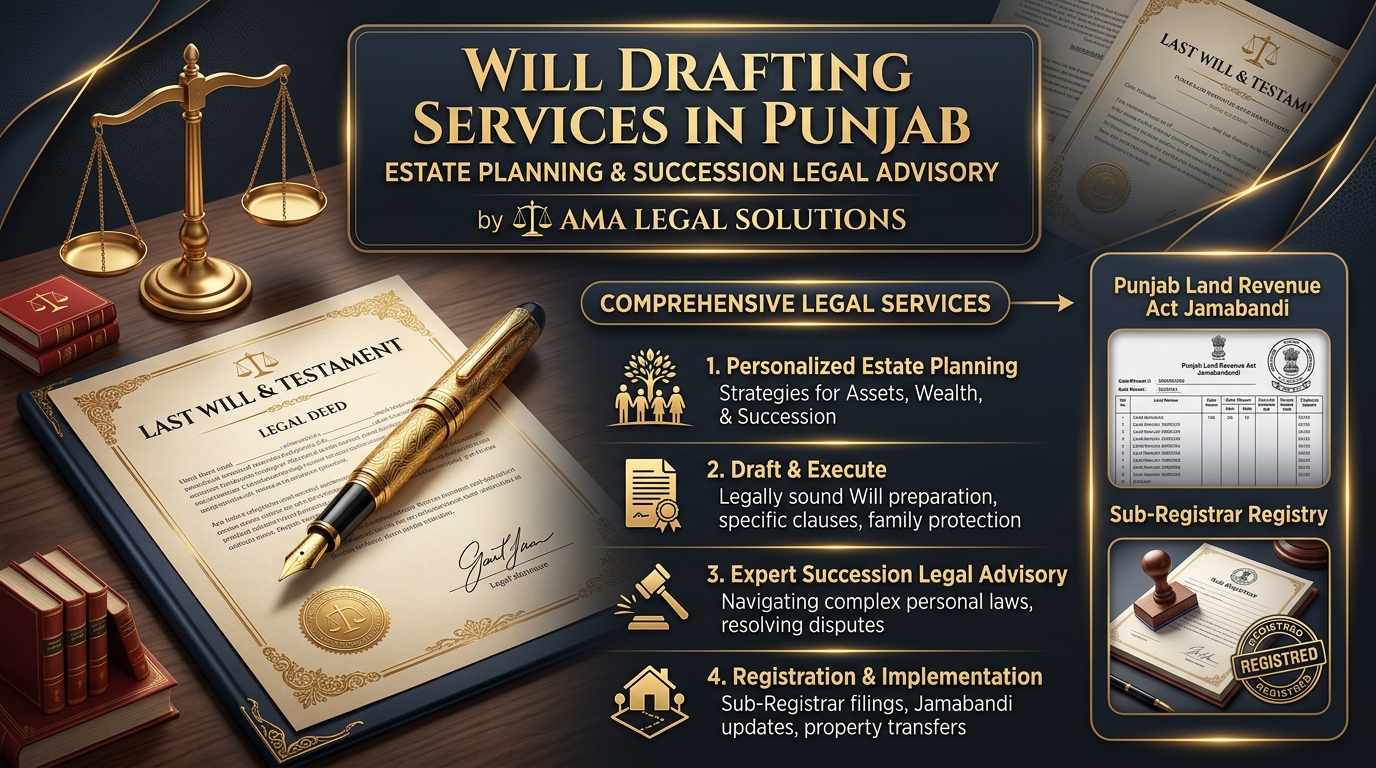
Quick Answer: What Do Professional Will Drafting Services in Punjab Cover?
Professional will drafting services in Punjab provide property owners and Non-Resident Indians (NRIs) with customized, court-admissible testamentary instruments drafted in strict compliance with Section 59 and Section 63 of the Indian Succession Act, 1925. Retaining experienced succession advocates ensures accurate legal scheduling of Greater Mohali Area Development Authority (GMADA) plots, GLADA commercial units, and agricultural Jamabandi revenue holdings, completely eliminating bitter family partition suits and enabling direct title mutation without the requirement of court probate. Transparent fixed legal advisory allows Punjab residents and overseas diaspora families to secure complete testamentary protection and Sub-Registrar registration guidance while avoiding excessive corporate law firm hourly retainers.
The Punjab Real Estate & Succession Landscape: GMADA, GLADA, Fertile Farmlands & the Global NRI Dimension
The State of Punjab represents one of India's most economically dynamic, agrarian-rich, and globally connected property landscapes. Across its three historic cultural regions—Majha, Doaba, and Malwa—real estate holdings exhibit deep historical roots intertwined with high-velocity urban expansion. In commercial hubs like Ludhiana (Model Town, Sarabha Nagar, Ferozepur Road corridor, Focal Point), SAS Nagar / Mohali (Sectors 68 through 82, Aerocity, IT City), Jalandhar, Amritsar, and Patiala, families hold high-value residential kothis, multi-storied commercial Shop-Cum-Offices (SCOs), and industrial manufacturing facilities. These urban assets are governed by regional development authorities, including the Greater Mohali Area Development Authority (GMADA), Greater Ludhiana Area Development Authority (GLADA), and Punjab Urban Planning and Development Authority (PUDA).
Simultaneously, Punjab's agrarian economy is anchored in fertile agricultural landholdings governed by the Punjab Land Revenue Act, 1887 (Act XVII of 1887). Generational wealth is preserved through complex revenue records maintained by the Halqa Patwari and Field Kanungo—including the Jamabandi (Register of Rights), Khasra Girdawari (crop inspection register), and Shajra Nasab (family pedigree table). When an estate owner dies intestate (without executing a valid will), their ancestral and self-acquired land is mechanically fragmented among Class I legal heirs under the Hindu Succession Act, 1956. Intestate succession frequently triggers bitter partition suits under Section 111 of the Punjab Land Revenue Act, paralyzing agricultural operations and tying up valuable land in revenue courts for decades.
Compounding this complexity is Punjab's massive Non-Resident Indian (NRI) diaspora settled across Canada (Surrey, Brampton, Calgary), the United Kingdom (Southall, Birmingham), the United States, Australia, and Europe. NRIs frequently retain valuable ancestral landholdings and residential estates across Doaba (Jalandhar, Hoshiarpur, Kapurthala, Nawanshahr) and Malwa. Absent a bulletproof, advocate-certified testament, NRI properties become prime targets for illegal encroachment, fraudulent General Power of Attorney (GPA) transfers, and fabricated unregistered wills propounded by unscrupulous relatives or property syndicates.
For Punjab estate owners and global NRIs seeking commercial will drafting services in Punjab, traditional options have been profoundly deficient. Large corporate law firms impose prohibitive hourly retainers that treat estate planning as a luxury private banking add-on, while cheap automated online DIY portals churn out generic English forms that fail in Punjab courts. Headquartered in North India with deep litigation expertise before the High Court of Punjab and Haryana at Chandigarh, AMA Legal Solutions bridges this gap. We provide bespoke, court-tested testamentary drafting by senior High Court advocates through a transparent, fixed legal advisory model with zero hourly billing markups.
Statutory Framework: Testamentary Requisites under the Indian Succession Act, 1925
“Section 59 of the Indian Succession Act, 1925 provides that every person of sound mind not being a minor may dispose of his property by Will. Under Section 63, the testator shall sign or affix his mark, attested by two or more witnesses, each of whom has seen the testator sign or affix his mark in their presence.”
Every will executed within the State of Punjab must satisfy strict statutory standards set forth in the Indian Succession Act, 1925 and authoritative rulings of the Punjab and Haryana High Court:
- Sound Testamentary Disposing Capacity (Section 59): The testator must possess sufficient mental clarity to comprehend the nature of the transaction, the extent of their assets, and the natural claims of family members. For elderly testators in Punjab, securing a contemporaneous medical certificate from a registered civil surgeon or licensed physician is an indispensable safeguard against allegations of senility or dementia.
- Absence of Vitiating Factors: Coercion, Fraud & Undue Influence (Section 61): A will procured through physical restraint, deception, or emotional manipulation is void ab initio. When multi-crore urban properties in Mohali or unequal shares of ancestral farmland are bequeathed, advocate drafting includes specific factual recitals explaining the rationale for unequal distribution, dispelling judicial suspicions.
- Exemption from Stamp Duty in Punjab: Under Schedule I of the Indian Stamp Act, 1899 as applicable to the State of Punjab, no stamp duty is payable on the execution or registration of a last will and testament. Wills executed on plain bond paper carry full legal force and are entirely admissible before civil and revenue courts.
- Strict Independent Attestation (Section 63(c) & Section 67): The testator must sign in the physical presence of at least two adult witnesses. Crucially, under Section 67, any bequest, legacy, or beneficial interest devised to an attesting witness or their spouse is void. Beneficiaries must strictly never sign as attesting witnesses.
- Self-Acquired vs. Coparcenary Property (Section 30, Hindu Succession Act): A Hindu testator enjoys unrestricted power to bequeath self-acquired properties, commercial business assets, and personal bank accounts, as well as their defined undivided coparcenary share in ancestral Hindu Undivided Family (HUF) property. However, a testator cannot bequeath another coparcener's distinct share without prior partition.
Probate in Punjab: Is Court Probate Legally Mandatory for Punjab Properties?
A widespread myth circulating among property owners and NRIs in Punjab is that every will must obtain formal probate from a civil court before real estate can be transferred. Statutory law and binding judicial precedents provide a clear geographic exemption that shields Punjab residents from compulsory probate litigation:
⚖️ The Definitive Statutory Exemption under Section 213(1) & Section 57
Under Section 213(1) read with clauses (a) and (b) of Section 57 of the Indian Succession Act, 1925, obtaining probate or Letters of Administration is mandatory only if the will was executed within the historic Presidency towns of Kolkata, Chennai, and Mumbai, or if the immovable property bequeathed is located within those specific municipal boundaries.
Because Punjab was never part of a British Presidency town, the Full Bench of the Punjab and Haryana High Court in landmark judgments—most notably Ram Chand v. Sardara Singh (AIR 1962 P&H 382) and Kanhaiya Lal v. Satish Kumar—and the Hon'ble Supreme Court in Clarence Pais v. Union of India (2001) have settled that probate of a will is NOT mandatory in the State of Punjab. Beneficiaries armed with an authentic, advocate-drafted will can apply directly for title mutation before GMADA, GLADA, Municipal Corporations, and Tehsil revenue authorities without a court probate decree.
While probate is not legally compulsory in Punjab, voluntary probate remains available under Section 276 of the Act. When disgruntled relatives file frivolous civil challenges or foreign probate courts require judicial confirmation of an executor's title over Indian assets, an advocate-drafted will equipped with strict statutory compliance enables the executor to secure probate swiftly before the District Judge or the Punjab and Haryana High Court.
NRI Succession Safeguards: Protecting Punjab Assets from Overseas Jurisdictions
For Non-Resident Indians living in Canada, the UK, the United States, and Australia, managing ancestral and acquired real estate in Punjab involves severe succession vulnerabilities. Thousands of NRI families suffer protracted property disputes caused by forged unregistered wills, unauthorized caretakers, or fraudulent mutations sanctioned through collusive revenue officials:
Execution via Indian Consulates Abroad
Under the Diplomatic and Consular Officers (Oaths and Fees) Act, 1948, an NRI can execute a will in Vancouver, Toronto, London, or New York before the Indian Consular Officer. The consular seal and signature establish prima facie authenticity under Section 85 of the Indian Evidence Act, preventing claims of bogus execution.
Anti-GPA Revocation & Safeguard Clauses
Advocate drafting incorporates explicit clauses declaring all prior general or special powers of attorney (GPAs/SPAs) executed regarding Punjab properties null and void, revoking any implied authority granted to local caretakers, tenants, or distant relatives.
Video Attestation & Digital Records
To withstand cross-border evidentiary challenges under Section 68 of the Indian Evidence Act, our advocates facilitate simultaneous audio-video recording of the testator and attesting witnesses during execution, archiving tamper-proof digital proof of sound mind and voluntary consent.
Harmonization with Foreign Wills
NRIs often hold assets both in Punjab and in their country of residence. An advocate-drafted Indian will is crafted to govern immovable properties in India exclusively, structured so that it neither revokes nor conflicts with a separate foreign will governing offshore investments in Canada, the UK, or the USA.
Comparative Matrix: Free DIY Templates vs. Corporate Retainers vs. AMA Legal Solutions
Punjab property owners and NRIs evaluating testamentary drafting services must compare legal enforceability, revenue land expertise, and fee transparency:
| Evaluation Parameters | Automated DIY Online Templates | AMA Legal Solutions (Punjab) | Tier-1 Corporate Law Firms |
|---|---|---|---|
| Legal Counsel & Accountability | Zero legal advice; explicit “as-is” liability disclaimers | Senior High Court succession advocates directly responsible | Junior associates draft; partners review at billing markups |
| Punjab Land Laws (GMADA, GLADA & Jamabandi) | Completely omitted; generic text causes revenue rejection | Precise scheduling compliant with GMADA rules & Tehsil Dakhil Kharij | Included, but billed as separate real estate advisory modules |
| Fee Structure & Commercial Model | Unreliable free tier or hidden recurring subscription charges | Transparent fixed legal advisory; zero hourly retainers | Exorbitant hourly billing rates and heavy advance retainers |
| Court Admissibility & Evidentiary Strength | Highly vulnerable to undue influence challenges in civil suits | Court-tested clauses with medical fitness and witness protocols | Legally strong, but cost-prohibitive for private families |
| Sub-Registrar Registration Guidance (NGDRS) | No physical or local administrative support provided | Complete appointment, NGDRS portal, and advocate identification support | Billed as an additional administrative clerkage expense |
| NRI Cross-Border Asset Integration | Incapable of handling cross-border jurisdictions or consular execution | Dedicated NRI testamentary structuring harmonized with overseas wills | Offered at premium international cross-border rates |
8 Critical Testamentary Clauses for Punjab Estates & High-Value Portfolios
An unassailable will drafted in Punjab must incorporate exact statutory covenants tailored to regional agrarian systems, urban development authority regulations, and family dynamics:
1. Absolute Revocation Clause
Under Section 62 of the Indian Succession Act, an unambiguous covenant revoking all prior wills, codicils, and powers of attorney executed in India or abroad prevents multi-document succession challenges.
2. Sound Disposing Mind Recital
A formal declaration affirming testamentary capacity under Section 59 and Section 61, supported by contemporaneous medical certification to defeat claims of undue influence or senility.
3. Exhaustive Revenue & GMADA/GLADA Schedules
Precise itemization of GMADA/GLADA allotment letters, conveyance deeds, and agricultural Jamabandi identifiers (Hadbast, Khewat, Khatoni, and Khasra numbers with specific canal water rights).
4. Executor Appointment & Succession Powers
Designation of a reliable primary and alternate executor under Section 222, conferring wide administrative authority to collect debts, defend suits, and execute mutations before Punjab authorities.
5. Urban Kothi & Commercial Demarcation
Clear demarcations for residential kothis and commercial SCOs in Ludhiana, Mohali, or Jalandhar, delineating separate floor ownership, parking spaces, terrace access, and easement rights.
6. Spousal Life Interest (Usufructuary Protection)
Creation of a protected life interest ensuring the surviving spouse retains exclusive residence and rental income without alienation rights, passing remainder title to children to prevent elder displacement.
7. Documented Disinherison Justifications
Where an estranged legal heir is excluded or receives an unequal bequest, detailing specific factual grounds (such as previous lifetime settlements or conduct) dispels judicial suspicions of unnatural disposition.
8. Exhaustive Residuary Estate Clause
A robust catch-all clause under Section 102 governing subsequently acquired real estate, demat shares, bank lockers, and omitted assets, preventing partial intestacy before civil courts.
The 6-Step Advocate Protocol for Dispute-Proof Will Drafting in Punjab
At AMA Legal Solutions, our succession advocates follow an established six-step protocol designed to eliminate administrative ambiguity and secure unassailable judicial enforceability:
Comprehensive Punjab Real Estate, GMADA, GLADA & Jamabandi Title Due Diligence
Our advocates conduct an exhaustive review of your immovable assets (GMADA freehold plots, GLADA commercial units, farmland Jamabandis, Lal Dora properties), bank accounts, demat holdings, and lockers across Punjab.
Family Tree Structuring, Heir Allocation & Disinherison Legal Safeguards
We analyze your family hierarchy and succession objectives, structuring contingent devises, protective life-interest trusts for dependents, and documented justifications if any Class I legal heir is excluded.
Senior High Court Advocate Testamentary Drafting & Statutory Covenants
A senior succession advocate drafts your bespoke testament, incorporating revocation covenants, sound-disposing capacity affirmations, executor mandates, and comprehensive residuary clauses under the Indian Succession Act, 1925.
Client Clause-by-Clause Review, Revenue Survey Verification & Executor Concurrence
You receive the draft in clear, rigorous legal language for meticulous review, ensuring all plot numbers, revenue Khasra details, bank account numbers, and beneficiary designations align perfectly with official records.
Medical Capacity Certification & Statutory Two-Witness Attestation
We guide you in securing a contemporaneous medical fitness certificate from a registered physician and supervise independent two-witness attestation under Section 63 to defeat future claims of undue influence.
Punjab NGDRS Sub-Registrar Registration & GMADA/Tehsil Mutation Dossier Preparation
For testators desiring definitive evidentiary security, we coordinate registration before the jurisdictional Punjab Sub-Registrar (via NGDRS) and structure the will for seamless post-mortem mutation before GMADA, GLADA, and Tehsil authorities.
Punjab Testamentary Architecture & Succession Blueprint
Visual guide to statutory compliance, GMADA/GLADA scheduling & Punjab estate planning
Prepared by AMA Legal Solutions Research & Succession Team • Punjab Testamentary Architecture & Succession Overview
NGDRS Sub-Registrar Registration & Property Mutation Protocols Across Punjab Authorities
A will fulfills its core legal objective only when designated beneficiaries can smoothly mutate property titles across urban and revenue authorities without facing administrative objections or protracted civil litigation:
🏛️ Sub-Registrar Registration via NGDRS Punjab
Under Section 18(e) of the Registration Act, 1908, registering a will is optional. However, registering before the jurisdictional Sub-Registrar or Joint Sub-Registrar (such as Ludhiana, Mohali, Jalandhar, Amritsar, or Patiala) through the National Generic Document Registration System (NGDRS Punjab / PLRS portal) creates conclusive official documentation. Digital photography, biometric thumb impressions, and advocate verification establish formidable evidentiary backing under Section 68 of the Indian Evidence Act, refuting subsequent allegations of forgery or coercion.
📋 Direct GMADA, GLADA & Municipal Mutation (No Mandatory Probate)
Beneficiaries under an advocate-drafted will can submit an application for transfer of ownership directly to the Estate Officer, GMADA or GLADA, alongside the death certificate, registered will, and legal heir affidavits. Similarly, Municipal Corporations (such as Ludhiana, Amritsar, and Jalandhar) process property tax assessment mutations without requiring a court probate decree when the testamentary disposition is uncontested.
🌾 Agricultural Land Mutation: Tehsil Jamabandi & Dakhil Kharij
For agricultural land, succession is formalized under Chapter IV of the Punjab Land Revenue Act, 1887. The beneficiary presents the will before the Halqa Patwari, who enters a formal mutation entry (Intiqal) in the register. Following field verification and notice to legal heirs, the Circle Revenue Officer (Tehsildar or Naib Tehsildar) sanctions the mutation, updating the official Jamabandi records without subjecting the estate to civil court probate proceedings.
Why Choose AMA Legal Solutions for Will Drafting Services in Punjab
Unlike unregulated online document aggregators that generate generic boilerplate text and disclaim all professional liability, AMA Legal Solutions is an established full-service law firm offering complete advocate-client privilege, trial-tested courtroom experience, and dedicated testamentary advisory across Punjab and North India:
Every testament is drafted, reviewed, and finalized by senior advocates actively practicing succession litigation before the Punjab and Haryana High Court and District Courts.
We eliminate unpredictable hourly billing and corporate retainers, providing complete cost transparency and accessible estate planning for Punjab and NRI families.
From drafting to coordinating official registration appointments via NGDRS across Ludhiana, Mohali, Jalandhar, or Amritsar Sub-Registrar offices, we manage the entire procedural lifecycle.
All your asset disclosures, family declarations, and estate instructions are protected under strict advocate-client confidentiality under Section 126 of the Indian Evidence Act.
Frequently Asked Questions on Will Drafting in Punjab
More Legal & Succession Guides
Will Drafting in Haryana
Expert estate planning, HSVP plots, and Jamabandi mutation compliance in Haryana.
Will Drafting in Gurugram
Testamentary drafting across Millennium City, builder floors, and DLF sectors.
Will Drafting in Delhi
Testamentary drafting across South Delhi, DDA sectors, and High Court jurisdiction.
Will Drafting in Delhi NCR
Comprehensive testamentary drafting across Gurugram, Noida, Delhi, and Faridabad.
Best Will Drafting Services in India
Compare advocate-led estate planning and testamentary advisory firms.
Drafting of Will: Complete Guide
Comprehensive statutory framework for executing an unassailable last will.
Simple Will Format Sample
Essential clause structure, witness attestation, and schedule formats.
Will Drafting Cheap & Accessible
Cost-effective, court-admissible testamentary drafting by senior advocates.
Will Drafting for NRIs
Cross-border asset planning and Indian consulate execution for global Indians.
NRI Will Drafting Affordable
Fixed legal fee testamentary structuring for overseas diaspora estates.
Will Drafting for Indians in Canada
Succession advisory for Indo-Canadians holding Punjab ancestral land.
Family Lawyer Advisory
Partition suits, succession dispute mediation, and estate dispute defense.
References & Statutory Authority
- Indian Succession Act, 1925 (Sections 57, 59, 61, 63, 67, 213)
- Registration Act, 1908 (Sections 18, 32, 40, 41)
- Hindu Succession Act, 1956 (Section 30 - Testamentary Disposition)
- Punjab Land Revenue Act, 1887 (Chapter IV - Mutation & Jamabandi Entries)
- Greater Mohali Area Development Authority (GMADA) Transfer Regulations
- Punjab and Haryana High Court at Chandigarh Case Law Portal
- Supreme Court of India Precedents on Testamentary Capacity & Probate Exemption
- Punjab Land Records Society (PLRS) & NGDRS Registration Portal
- Bar Council of Punjab and Haryana Standards of Professional Conduct

AMA Legal Solutions
Serving Punjab, High Court at Chandigarh, and NRI families globally with a 4.7 Google Rating, over 10,000+ Clients Served, 25,000+ Cases Handled, and more than 40+ Years of Combined Legal Experience in providing strategic testamentary drafting, estate planning, and succession advisory across Punjab and India.
About Author
Anuj Anand Malik
View ProfileAnuj Anand Malik, Founder of AMA Legal Solutions, is a senior advocate with extensive expertise in testamentary drafting, high-value estate planning, and succession litigation under Indian law across Punjab, the Punjab and Haryana High Court, and tribunals.
Connect on LinkedInNeed Will Drafting Help?
Get personalized guidance on drafting a legally binding testament under the Indian Succession Act. Advocate Anuj Anand Malik will review your requirements.
Call +91-8700343611Request CallbackClient Reviews
Based on verified client reviews
“Managing our ancestral agricultural land in Ludhiana, commercial SCOs in Mohali, and residential properties in Jalandhar while residing in Vancouver was a constant source of anxiety due to the rampant risk of fraudulent land mutations and forged succession claims. AMA Legal Solutions provided unparalleled legal stewardship in drafting our comprehensive family will under the Indian Succession Act. Advocate Anuj Anand Malik meticulously cataloged our revenue Jamabandi records, structured protective life-interest covenants, and harmonized the entire testament with GMADA and Punjab Land Revenue rules. Their transparent fixed legal advisory shielded us from the predatory hourly retainers of corporate law firms while delivering absolute High Court-tested peace of mind. For any resident or NRI seeking dispute-proof will drafting services in Punjab, AMA Legal Solutions is the gold standard.”
Harpreet Singh Dhillon
NRI Estate Owner, Vancouver (Canada) & Agricultural Landholder, SAS Nagar (Mohali) & Ludhiana • Verified Client