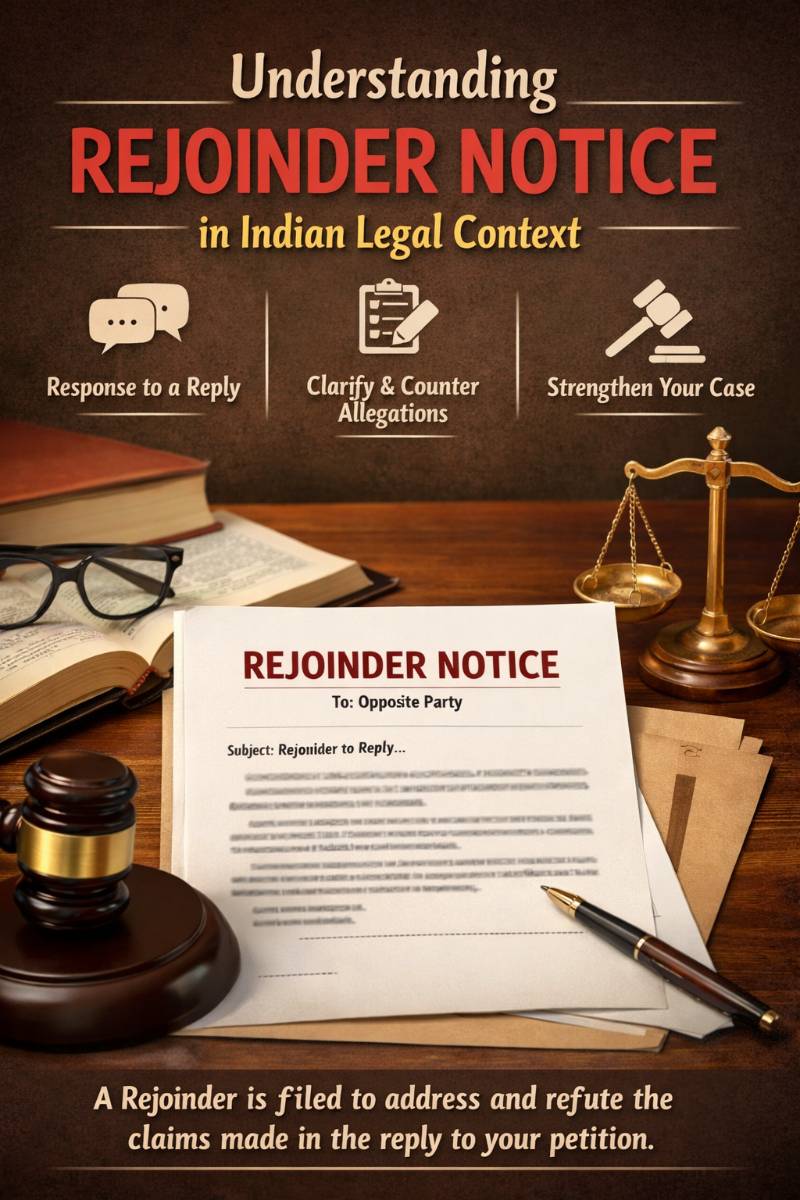
Understanding Rejoinder Notice in Indian Legal Context
A Detailed Guide on Rejoinder Notices in India

Anuj Anand Malik
Reviewed by AMA Legal Solutions
Understanding Rejoinder Notice in Indian Legal Context
A Rejoinder Notice is a crucial element in the legal proceedings of India, serving as the defendant's response to the plaintiff's reply. This structured response aims to clarify, counter, or further elaborate on issues presented in the litigation process, shaping the direction and outcome of the case. As legal proceedings grow more complex, understanding every document's purpose becomes increasingly essential, especially for litigants navigating the judicial system.
Given the intricate nature of legal battles, the concept of a Rejoinder Notice becomes pivotal. With its role in resolving nuanced legal issues and ensuring that each party's stance is thoroughly documented, it's not surprising that legal professionals place significant emphasis on crafting a precise and comprehensive rejoinder. This article delves into what a Rejoinder Notice entails, how to send one effectively, and its ramifications in Indian legal proceedings. Let's start by exploring its definition and the broader legal framework it operates within.
What is a Rejoinder Notice?
A Rejoinder Notice is essentially a formal written reply sent by the defendant or respondent in a legal dispute. It addresses the points raised by the plaintiff in their reply, often dissecting and countering allegations with detailed arguments and evidence. This legal document is instrumental in clarifying contested facts and providing the court with a clearer understanding of the case from the defendant's perspective.
The Role of Rejoinder in Legal Proceedings
The rejoinder holds importance in forming the triad of pleadings that comprises the initial complaint, followed by the reply, and then the rejoinder. It forms a basis for the court's understanding, presenting a rounded view by allowing the defendant to present their case against new arguments raised by the plaintiff, often after the plaintiff's reply to the initial defense.
Importance in Resolving Disputes
Clarifies the defendant's position, providing a counter-narrative.
Ensures all allegations are addressed before moving forward with evidence presentation.
Determines the focus for subsequent hearings or trial stages.
How to Draft a Rejoinder Notice
Crafting a rejoinder notice requires meticulous attention to detail and a deep understanding of the case specifics. Legal professionals with expertise in litigation, such as those at AMA Legal Solutions, can provide invaluable assistance in ensuring all points are duly addressed. Here’s how one might go about drafting a rejoinder:
Step-by-Step Guide
1. Collect Evidence and Analyze the Plaintiff’s Reply
Review the plaintiff’s reply critically, note contradictions, and gather supporting documents that reinforce your stance.
2. Structure the Rejoinder Clearly
Introduction: Reiterate the purpose of the rejoinder.
Body: Address each point raised by the plaintiff, citing evidence and legal precedents.
Conclusion: Summarize the main points and introduce any new defenses.
3. Legal Drafting
Engage legal experts to craft the draft to ensure it adheres to legal norms and is persuasive. Services like legal drafting at AMA Legal Solutions offer professional assistance in this domain.
4. Filing and Sharing with Opposing Counsel
File the rejoinder notice following the procedural requirements of the concerned court and ensure the opposing counsel receives a copy, as required.
Common Challenges in Rejoinder Notices
Addressing Legal Complexities
Diverse and intricate issues in litigation require precise articulation in rejoinders. Problems often include ambiguity in legal terms, misinterpretation of reply points, and the challenge of maintaining coherence amidst extensive documentation.
Strategies to Overcome Challenges
Engage specialized legal services like corporate legal services for in-depth understanding.
Use case studies to support the points made in the rejoinder.
Ensure factual accuracy and relevance to strengthen your arguments.

Bank Compromise Settlement & Debt Relief
Case Study: Application of Rejoinder Notice in Indian Courts
Illustrative Example
Consider a scenario involving intellectual property rights, a prevalent issue in Indian courts. Let’s assume a case where Company A accuses Company B of patent infringement. Company B responds with a defense, and Company A subsequently furnishes a detailed reply refuting those defenses. In response, Company B files a rejoinder notice:
Company A's Reply: Claims that Company B’s product exhibits X, an aspect of their patent.
Company B's Rejoinder Notice:
Refutes Claim 1 by demonstrating X is generic pre-existing knowledge.
Presents technical documents validating non-infringement.
Cites previous cases like 'ABC Corp vs XYZ Ltd' supporting their stance.
Such a structured rejoinder aids in demystifying technical aspects, aiding judicial clarity. The outcome heavily relies on the ability to convincingly argue positions and leverage supporting evidence prudently.
The Legal Framework and Principles
Procedural Aspects in Indian Judiciary
The rejoinder operates within the norms set by the Civil Procedure Code (CPC) and varies slightly depending on whether the case is civil, corporate, or criminal in nature. For instance, in civil matters, response timelines and permissible content are guided by specific procedural rules.
Relevant Legal Provisions
Filing a rejoinder involves adhering to certain procedural mandates:
Jurisdictional Matters: Filing at the district, state, or higher courts.
Timeframes: Vary depending on interim orders or procedural deadlines prescribed by the court.
Documentation: Requisite stamps, identification proofs, and previous pleadings included.
Legal Services at AMA Legal Solutions
Understanding the legal framework related to rejoinders can be complex. Criminal law services and civil legal services at AMA Legal Solutions are designed to guide clients meticulously through the procedural intricacies involved.
The Process of Sending a Rejoinder Notice
Legal and Practical Considerations
Sending a rejoinder notice involves a series of legal and practical steps. This process is crucial to ensuring the rejoinder is received, acknowledged, and considered by the opposing party and the court:
1. Surpassing Deadlines
Ensure compliance with legal timelines to avoid rejection due to procedural delays.
2. Formulating a Notice of Execution
Prepare notice of execution or intent to deliver the rejoinder to the concerned parties.
3. Delivery Method
Personal Delivery: Often handled through legal representatives or court-appointed officials.
Registered Mail: Provides proof of delivery via postal acknowledgment receipt.
Digital Means: Some jurisdictions permit electronic submissions through certified portals.
4. Record-Keeping
Maintain copies of all notices, proofs of sending, and acknowledgment receipts to support procedural compliance.
The Role of Technology in Rejoinder Handling
Technology enhances transparency, record-keeping, and efficiency in rejoinder handling. Collaborate with technology firms specializing in legal tech to streamline document management, compliance tracking, and case preparation. This is crucial when dealing with complex cases like cyber disputes where cyber law services play a pivotal role.
Maximizing the Efficacy of Rejoinders
In conclusion, a Rejoinder Notice is a fundamental instrument in the legal landscape of India, used to clarify and counterpoints in litigation processes. Its strategic preparation and execution can significantly influence the trajectory of a legal battle. As such, utilizing comprehensive legal support services such as those provided by litigation professionals at AMA Legal Solutions is recommended. These experts bring a wealth of knowledge and an analytic approach to crafting rejoinder notices that stand up to scrutiny and meet the highest standards of legal rigor.
To fully leverage the benefits of a rejoinder in your legal strategy and navigate the nuanced terrain of legal proceedings, consider availing specialized legal services that ensure meticulous preparation, compliance, and presentation.
For further assistance and expert legal advice on drafting and filing rejoinders, contact AMA Legal Solutions here.
Need Strategic Legal Defense for Your Situation?
Our banking & litigation advocates review your notices, debt liability, and recovery issues under complete advocate-client secrecy.

AMA Legal Solutions
Trusted with a 4.7 Google Rating, over 10,000+ Clients Served, 25,000+ Cases Handled, and more than 40+ Years of Experience in providing strategic legal defense and debt resolution across India.
Our media coverages





Client Reviews
"AMA Legal Solutions provided comprehensive assistance in understanding and drafting a Rejoinder Notice for my case, ensuring thorough analysis and strong legal articulation."
Anjali Mehta
"AMA Legal Solutions is top-notch in understanding complex litigation facets, making Rejoinder drafting a straightforward task."
Priya Iyer
"The team at AMA Legal Solutions guided me extensively through the nuances of legal documentation, crucial for my corporate legal dispute."
Rahul Verma
"Highly impressed with the meticulous attention to detail by AMA Legal Solutions on making the Rejoinder Notice effective in court."
Sneha Kapoor
"Navigating legal challenges became seamless with AMA Legal Solutions' expert advice on crafting precise legal documents."
Vikram Singh
Frequently Asked Questions
Related Articles
RuPay Credit Card on UPI Default & Credit Line on UPI Settlement (2026)
Micro-transactions on RuPay UPI Credit Cards and pre-approved 'Credit Lines on UPI' have triggered a massive wave of 42%+ APR revolving debt traps. Find out if defaulting blocks your personal savings UPI and how to settle RuPay UPI credit dues for 30%–50%.
Read Article
Paytm, PhonePe & BharatPe Daily EDI Merchant Loan Settlement (2026)
Drowning in Equated Daily Installment (EDI) merchant loans where 100% of your daily QR Soundbox collections are auto-swept before you can pay suppliers or rent? Learn how retail shopkeepers and MSMEs legally halt QR sweeps and negotiate a 50%+ OTS.
Read Article
Can Bank or Loan App Remotely Lock Phone for EMI Default? RBI Rules (2026)
An investigative breakdown of RBI's Remote Device Locking Directions—explaining why lenders cannot lock your phone for personal loans, the mandatory 30/60 DPD safeguards on financed devices, the Rs. 250/hour delay penalty, and how to settle device & app loans.
Read ArticleAbout Author
Anuj Anand Malik
View ProfileAnuj Anand Malik, Founder of AMA Legal Solutions, is a trusted advocate, loan settlement expert, legal advisor, and banking lawyer. With over a decade of experience in loan settlement, corporate law, financial disputes, and compliance, he leads a result-driven law firm based in India that helps individuals, startups, and businesses achieve legal and financial stability.
Connect on LinkedInNeed Legal Representation?
Evaluate your defense against recovery agents, notices, or structure your loan settlement directly with Senior Advocates.
Call +91-8700343611